

Table of Contents
Some links on posts are affiliate links and will earn us a commission from qualifying purchases
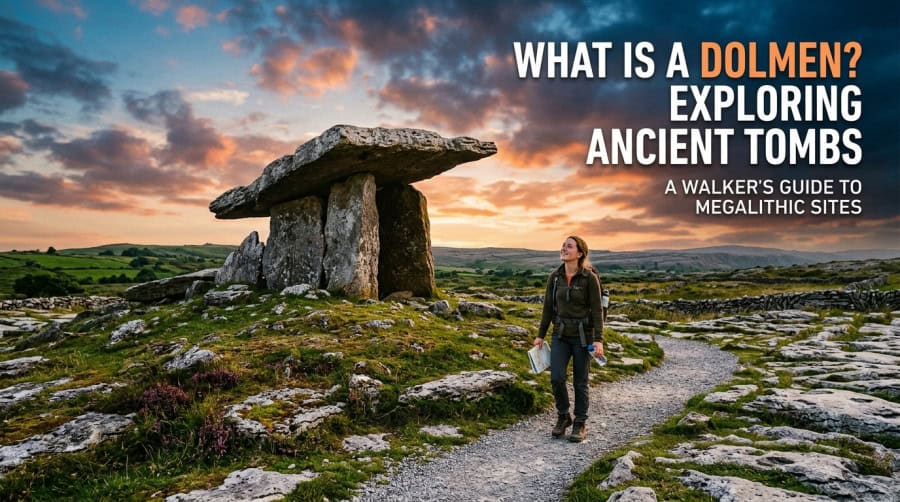
You will spot dolmens as simple stone tables on walks across moors, coasts, and river valleys – they are single-chamber megalithic tombs built in the Neolithic to hold the dead and mark important places in the landscape. Dolmens usually consist of upright stones that support a large flat capstone, forming a burial chamber or portal tomb used for burials and ritual activity.
As you approach one, you’ll notice their bold, weathered shapes and wonder how people moved and raised such heavy stones thousands of years ago. The rest of the article will show you what a dolmen looks like, why people built them, where the best examples stand, and what to look for when you come across one on a walk.
Key Takeaways
- Neolithic Burial Chambers: Dolmens are single-chamber megalithic tombs used primarily for ancient burials.
- Engineering & Ritual: You can learn about prehistoric construction and ritual meaning directly from the stones and their landscape setting.
- Global Footprint: Many famous dolmens survive across Europe and beyond, ready to explore on foot.
Defining Dolmens and Megalithic Monuments
Dolmens are stone-built burial chambers made from large upright stones that support a single or several flat capstones. You will see them called many names, and they come in several basic layouts and sizes.
Typical Structure and Key Features
A dolmen usually has two or more upright stones (supporting orthostats) that hold up a heavy capstone. That capstone forms the roof of a small chamber used for burial or ritual deposits. Many examples are simple dolmen types: a single chamber with minimal entrance.
You will also find portal dolmens with a marked entrance pair of uprights, rectangular dolmens with longer chambers, and great dolmens or chambered tombs that are larger and sometimes long enough to walk inside. Small pad-stones may be used to level the capstone. Builders often covered the stone chamber with earth or stone to make a mound, though some dolmens stand exposed.
Terms you may encounter include:
- Megalith / Megalithic Structure: Any large-stone monument.
- Cromlech, Quoit, Hunebed (Dutch), Hünengrab (German), Anta or Dös: Regional names pointing to large stones, but sharing the core feature of a capstone supported by uprights.
Origins of the Term and Regional Names
The word dolmen comes from Breton and entered archaeology to name these table-like stone tombs. Different regions use local words: quoit in parts of Britain, hunebed in the Netherlands, Hünengrab in German-speaking areas, and anta in Iberia. Korea and parts of Asia use their own terms for very large concentrations of dolmens.
Archaeologists often prefer precise names by form or function rather than a single label. For example, portal tomb describes a dolmen with a logical entrance, while chambered tomb stresses its use as a communal burial place. Using regional names helps you recognise local styles and dating traditions when you visit sites.
Difference From Other Megalithic Sites
Dolmens are a subset of megaliths — large-stone monuments — so knowing the differences helps when you walk a site:
| Monument Type | Core Structure | Primary Use / Features |
| Dolmen | Built chamber with capstone on uprights | Single-chamber tomb for burials and ritual deposits |
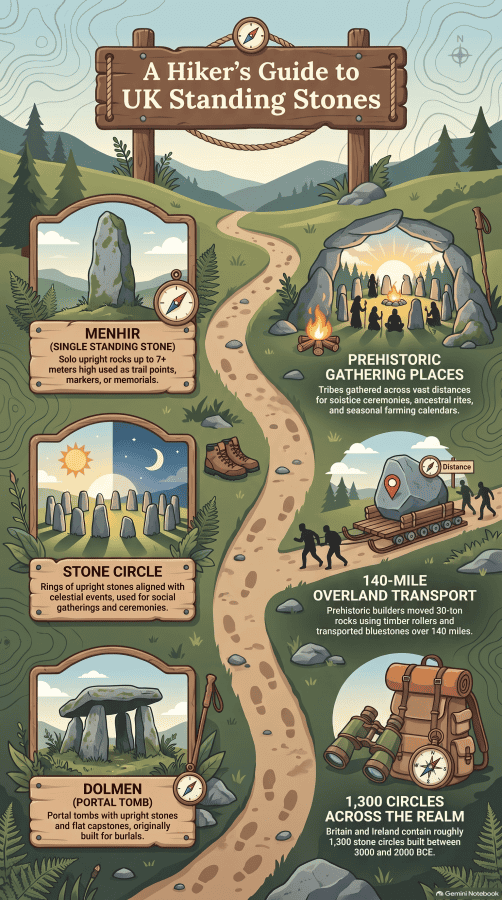
| Menhir | Single standing stone | Boundary marker, route mark, or ritual focal point |
| Stone Circle | Ring of multiple upright stones | Communal or ceremonial space (e.g. Stonehenge) |
| Passage Grave | Long entrance passage leading to a chamber | Extended burial mound often aligned with solar events |
Construction, Architecture, and Engineering
This section explains how Neolithic builders moved and shaped large stones, how styles differ by region, why capstones and uprights matter, and how chambers often linked to mounds or barrows.
Building Techniques of the Neolithic Period
You will see that builders used simple tools and a lot of planning. They quarried or collected large stone slabs and menhirs, then moved them with ropes, timber rollers, sledges, and manpower. Lifted capstones may have been hauled up earthen ramps or levered into place with wooden A-frames.
Teams organised food and labour for weeks or months. Evidence from surviving sites and experiments shows that cattle, ropes, and wooden rollers reduced friction. Builders sometimes shaped stone faces to fit uprights, improving stability. Small mistakes could collapse a structure during construction, so careful staging mattered.
Architectural Variations and Regional Styles
You will notice clear differences between regions:
- Brittany and Ireland: Passage graves and large chambered tombs use long passages and big capstones.
- Britain: Portal tombs often show two tall uprights at an entrance, giving a distinct doorway feel.
- Korea: Dolmens often appear as flat capstones on short uprights, forming table-like megalithic structures.
Some areas favour chambered long barrows with elongated internal chambers under a tumulus. Other regions leave chambers exposed or ring them with small kerb stones. Local rock type and social customs shaped each style, so you can often tell where a dolmen was built by its layout and the stones used.
The Role of Capstones and Upright Stones
You will find that capstones and uprights define a dolmen’s strength and purpose. Upright stones form the chamber walls while the capstone acts as the roof. Capstones range from modest slabs to massive blocks weighing many tonnes; the largest require precise placement to avoid collapse.
Builders set uprights into sockets or bedded them on levelled ground to resist movement. Some capstones were shaped to sit firmly on multiple uprights, creating a sealed chamber for interments. In portal tombs, the pair of portal uprights mark the entrance and carry ritual significance as well as load.
Use of Burial Chambers and Mounds
You will often see chambers used as communal burial spaces. Human bones, pottery, and animal remains from many sites show repeated use over generations. These chambered tombs could contain mixed or layered deposits, suggesting collective burial and ancestor veneration.
Many dolmens were later covered by a burial mound or tumulus, forming a barrow that hid the stonework. In other cases the stone chamber stayed exposed but sat within a defined kerb of smaller stones. The presence or absence of a mound affects how the site looked in the landscape and how easily you can spot its original function today.
Burial Practices and Cultural Significance
Dolmens and related megalithic tombs served as long-term places for the dead, places of repeated ritual, and markers of social ties. They often contain built burial chambers, passages, or were covered by burial mounds, and the way people used them tells you about belief, memory, and community.
Funerary Rites and Ancestor Worship
You will find human bones, pottery, and animal remains in many burial chambers, showing repeated funerary activity over centuries. Excavations of chambered tombs and passage graves reveal bones mixed together, suggesting bodies were moved, reburied, or placed in collective deposits rather than left as single graves.
Evidence of hearths and food fragments at some sites implies people held rituals or feasts near the tomb entrance. Those communal acts likely honoured ancestors and kept their memory alive. Megalithic art – carvings on capstones or portal stones – may mark sacred spaces and link the living to ancestors in symbolic ways.
Communal and Individual Graves
Dolmens functioned both as communal tombs and as elite burials, depending on place and period:
- Communal Repositories: In many late Neolithic passage graves, you will see dozens of individuals placed over centuries inside a single chamber.
- High-Status / Individual Burials: By contrast, some portal tombs and smaller megalithic tombs hold single or a few high-status burials, sometimes with grave goods.
Look for differences in size, construction, and grave goods: larger capstones and elaborate passage graves often reflect wider community effort or higher social standing.
Ritual Use and Spiritual Beliefs
You can read ritual behaviour from placement and construction. Passage orientation at certain sites lines up with sunrise or seasonal light, suggesting cosmological meaning tied to death and renewal. The presence of burial mounds covering some dolmens shows a desire to mark and protect the place of the dead.
Objects found with the dead – pottery, tools, animal bones – point to offerings or practical beliefs about an afterlife. The repeated return to tomb entrances for feasting or commemoration indicates these sites were not simply storage for bodies but active centres for spiritual practice and community memory.
Iconic Dolmen Sites and Famous Examples
You will find dolmens across Europe and Asia that show different building styles, sizes, and local uses. Some sites are easy to visit on walking routes, while others sit in wider megalithic landscapes with standing stones and passage graves.
Poulnabrone and Other Notable Sites in Ireland
Poulnabrone Dolmen sits on a limestone pavement in the Burren, County Clare. The capstone tilts like a table and rests on slender uprights, creating a compact chamber where excavations found skeletons and Beaker pottery dated to c. 3800–3200 BC. You can reach it by a short walk from nearby car parks; the site is open and very exposed, so bring sun or rain protection.
Other Irish sites include brown-shingled portal tombs and larger passage graves. Many are set in rolling pastures or coastal moors and often have small information panels. When you visit, note the scale of the capstones and the low entrances that suggest the chambers were not built for standing long-term inside.
The Carnac Stones and French Dolmens
Carnac in Brittany combines long stone alignments with dozens of dolmens and passage graves. The nearby dolmen Er-Roc’h-Feutet and other Breton megaliths show large, carefully worked capstones and frequent associations with earthen mounds. In Carnac itself, alignments stretch for kilometres and create a striking landscape of upright stones.
You can walk marked trails through fields and woodlands to view dolmens up close. Many Breton dolmens were once covered by tumuli, so you often see the stone chamber entrance and part of the mound. Look for carved capstones and reused menhirs that reveal local reuse and change over millennia.
British Megaliths: Trethevy Quoit, Chûn Quoit, and More
- Trethevy Quoit (Cornwall): Features a heavy capstone supported on tall uprights and stands amid pasture with easy access from nearby lanes.
- Chûn Quoit (Cornwall): Sits above moorland with views out to the sea; its compact chamber has a squat, domed capstone.
Across Britain you will find portal dolmens, gallery graves, and isolated capstones. Many are waymarked on walking routes and sit close to ancient field systems. When you plan a walk, check for fragile surfaces and avoid climbing on stones; these monuments survive because they remain largely in their original position.
Asian Dolmens: Ganghwa and Beyond
Ganghwa Island near Seoul hosts hundreds of Korean dolmens that differ in form from European types. Ganghwa dolmen sites include table-like capstones and often larger, flatter supports. These dolmens date broadly from the Bronze Age to later periods and form dense clusters rather than isolated tombs.
Other Asian regions, including the Caucasus and parts of Indonesia, show local styles and materials. If your walk brings you to a dolmen cluster, you’ll often find interpretive signs explaining local chronology and the cultural links between dolmen forms, burial practice, and territory.
Dolmens in the Broader Context of Megalithic Landscapes
Dolmens often stand where other stone monuments cluster. You will find them near single standing stones, stone circles, and long mounds, each type showing different uses and meanings in the landscape.
Relationship to Menhirs, Stone Circles, and Other Structures
- Menhirs: Markers or focal points often placed near dolmens. In Brittany and Britain, menhirs sometimes align with dolmens to create sightlines across fields or to the horizon.
- Stone Circles: Public ritual spaces; dolmens usually serve burial roles at the margins rather than at their centre.
- Passage Graves / Cairns: Show variations on the chambered tomb concept. In some sites, a dolmen’s capstone matches nearby standing stones in shape and quarry source, suggesting shared planning and labour.
Dolmens in the Neolithic and Beyond
Dolmens first appear in the Neolithic when farming communities settled landscapes. You will often date northwest European dolmens to 4000–3000 BC, while places like Korea show later or continuing use. These sites offered communal burial and ancestor veneration across generations.
Over time, some dolmens were covered by earthen mounds or left exposed. You will find evidence of repeat use: mixed human bones, pottery, and animal remains in many chambers. That shows burial, ritual feasting, and long-term memory of place. In later periods people reused or respected dolmens, sometimes adding standing stones or arranging fields around them.
Preservation, Tourism, and Modern Appreciation
You will find dolmens visible in museums, guidebooks, and walking routes. Protection varies: UNESCO lists some Korean and European sites, while many rural dolmens depend on local conservation groups. Weathering, farming, and development remain threats to unprotected sites.
Visiting responsibly matters. Stick to paths, avoid climbing fragile capstones, and follow local signs. Many areas now provide information panels that explain dating, finds, and likely rituals. For walkers, dolmens add visible links to past landscapes.
Frequently Asked Questions
What were dolmens used for in prehistoric communities?
Dolmens served mainly as burial chambers where communities placed human remains. Archaeologists often find mixed bones, pottery, and animal bones inside or nearby. They also marked special places in the landscape, acting as focal points for rituals, feasting, or ancestor veneration across generations.
How were dolmens built without modern tools?
Builders used simple tools, teamwork, and local materials. They moved and raised large stones using ropes, wooden rollers, levers, and earthen ramps, powered by teams of people or livestock. Small pad-stones and packed earth were used to level and set the heavy capstones in place.
What is the difference between a dolmen, a cairn, and a cromlech?
- Dolmen: A stone chamber made from upright stones capped by a large flat stone, functioning as a tomb.
- Cairn: A mound of earth or piled stones that may cover a burial chamber or mark a route on a hill.
- Cromlech: An older term used variably; in British usage it sometimes means a stone circle. Archaeologists avoid using cromlech when referring strictly to a dolmen or cairn.
Is Stonehenge considered a dolmen, and why or why not?
Stonehenge is not a dolmen. It is a complex stone circle and monument made from many uprights and lintels arranged in concentric rings. Dolmens are single-chamber tombs with a capstone supported by uprights. Stonehenge served broader ceremonial and astronomical roles with a completely different layout and scale.
What is the link between dolmens and menhirs in megalithic landscapes?
Menhirs are single standing stones, while dolmens are chambered structures made from several stones. Both belong to the same megalithic tradition and frequently appear together in the landscape. Menhirs often marked territory, routes, or sightlines leading to or surrounding dolmen sites.
Where can you find notable examples of dolmens in the UK and Europe?
In the UK and Ireland, visit Poulnabrone in County Clare (Ireland), Brownshill in County Carlow (Ireland), and portal dolmens like Trethevy Quoit in Cornwall or Pentre Ifan in Wales. Brittany in France features extensive passage-grave dolmens near Carnac, while Spain, Portugal, Scandinavia, and South Korea host thousands of well-preserved sites.
What is a dolmen? Learn how prehistoric communities built these iconic stone table monuments, why they were made, and where to find the best sites on foot.
Recent Posts
Long before maps, towns, or smartphones existed, ancient communities were hauling massive rocks into fields and setting them upright - these are known as standing stones. Spanning from single...
You spot earth banks curving over a skyline and wonder what people once did up there. A hill fort is a raised, defended settlement - often a ring of banks, ditches and entrances - where communities...