

Table of Contents
Some links on posts are affiliate links and will earn us a commission from qualifying purchases
You spot earth banks curving over a skyline and wonder what people once did up there. A hill fort is a raised, defended settlement – often a ring of banks, ditches and entrances – where communities lived, worked and sheltered in prehistoric Britain. You can see how terrain, earthworks and traces of past activity together mark places that were homes, meeting spots and defensive sites.
Walkers find hill forts across the UK on ridges, spurs and promontories, each with its own shape, age and story. Knowing what to look for – banks, ditches, entrances and interior traces – helps you spot the site’s purpose and imagine how people used the space long ago.
Key Takeaways
- Hill forts are raised, defended prehistoric settlements marked by banks and ditches.
- They vary in size, form and age across the UK and often sit on high ground.
- You can explore features on foot to understand their history and conservation needs.
Defining Hill Forts: Structure and Function
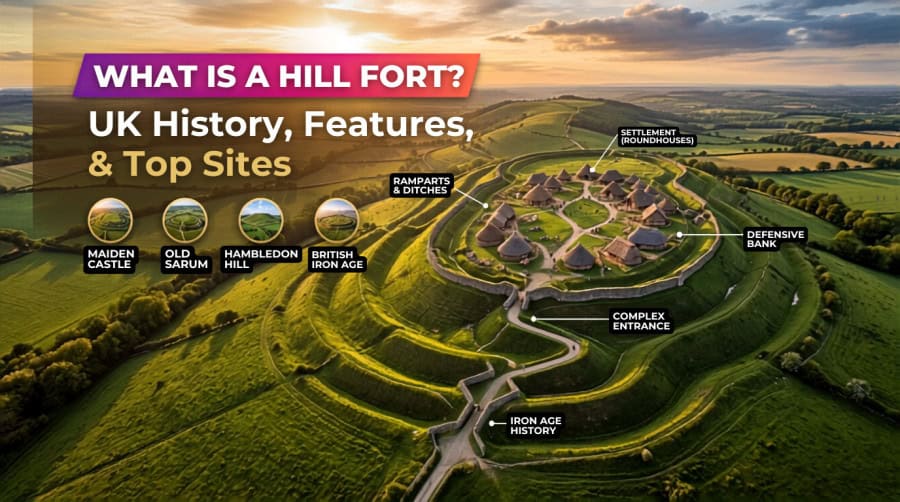
Hill forts are raised sites with built defences and an enclosed interior where people lived, worked or sheltered. You will see earth or stone ramparts, ditches cut around the edge, engineered entrances and traces of roundhouse foundations inside.
Key Elements: Ramparts, Ditches, and Entrances
Ramparts form the main visible defence of a hillfort. They are banks of earth, stone or timber-built revetments that rise above the interior ground level. You will often find one (univallate) or several (multivallate) concentric ramparts.
Ditches usually sit outside the rampart. They provided material for the bank and made an enemy’s approach steeper and slower. Look for filled or shallow hollows today; original profiles are often eroded.
Entrances were planned features, not gaps. Designers used narrow passageways, overlapping banks and outworks to control access. Complex entrances show signs of timber gates, guard platforms, or staggered turns that channel movement.
Enclosures: Defended Settlements and Roundhouses
A hill fort is fundamentally an enclosed place. The enclosure could cover less than a hectare for a farmstead or many hectares for a community or seasonal market. The size affects how the interior was used.
Inside you may find roundhouse platforms, post-holes and hearths. Houses were usually timber framed and filled with wattle and daub walls. Storage pits, workshops and animal pens also appear in excavation reports.
Some hillforts were year-round settlements; others seem seasonal or used only in times of threat. The earthworks defined usable space and helped organise domestic, craft and animal areas within the defended enclosure.
Purpose: Defence, Status, and Community
Hill forts served more than one purpose. They offered defence when needed, using ramparts and controlled entrances to delay attackers. But many contain few direct signs of sustained warfare.
They also acted as displays of power and wealth. Large multivallate ramparts and extensive enclosures signal control over landscape and resources. Markets, gatherings and craft production could take place inside.
You should see hillforts as multifunctional: defensive works, communal centres, and symbols of local status. Their form – ramparts and ditches, planned entrances and internal roundhouses – reflects these mixed roles.
Origins and Evolution Through the Ages
Hillforts grew from earlier burial and ritual sites and then changed with shifting social needs, technology and trade. You will see links to Bronze Age barrows, major Iron Age hillforts, and later forms such as oppida and medieval reuses.
From Bronze Age Barrows to Iron Age Hillforts
Bronze Age barrows often mark the earliest visible activity on many hilltop sites. You may find barrows incorporated into later defensive earthworks, showing sacred or ancestral importance that attracted later builders.
By around 1000–800 BC communities began building stronger banks and ditches. In Britain the trend peaks in the Iron Age, when larger hillforts appear with multiple ramparts. These Iron Age hillforts vary in size from small enclosures to big social centres like Maiden Castle.
When you visit a hillfort, look for layered features: earlier burial mounds, later banks, and entrances reworked over time. These layers reveal gradual growth from ritual places to settlements with defensive and social roles.
Cultural Development: Oppida, Pfostenschlitzmauer, and Later Changes
As populations and trade grew in the later Iron Age, some hilltop sites expanded into oppida – large, organised towns with streets, workshops and markets. You can see this shift in sites that show planned layouts and signs of craft production.
In parts of central Europe, builders used the pfostenschlitzmauer technique: timber posts set into stone facings to make strong walls. That method shows how communities adopted new engineering for greater strength and status.
By the end of the Iron Age, many hillforts served economic and symbolic roles as much as defensive ones. When you study ramparts and internal features, they often reflect changing social complexity, trade connections and craft specialisation.
Hillforts in the Early Medieval and Medieval Periods
After the Roman period, some hillforts saw renewed use in the early medieval centuries. You might find reoccupied sites that served as local strongholds, refuge places or seats for regional leaders.
In the medieval period many hilltops were repurposed for stone castles or abandoned when new political centres rose in valleys. Where castles replaced earthworks, traces of both periods can survive together.
When you walk a site, note reused ditches, later masonry and altered entrances. These signs indicate how communities adapted older hillforts to new military needs or social orders across centuries.
Types of British Hillforts and Their Regional Variations
Hillforts vary by their number of defensive lines, their position on the landscape, and by region. You will see simple single-rampart sites, complex multi-rampart forts, cliff-edge promontory forts, and smaller hill-slope enclosures with local differences across England, Wales and Scotland.
Univallate and Multivallate Structures
Univallate hillforts have a single circuit of rampart and ditch. You will often find them on smaller hills or where the slope gives natural defence. They are common in areas where communities needed simple, quick defences or where farming communities lived close by.
Multivallate hillforts have two or more concentric ramparts and ditches. These are usually on prominent summits and show greater investment of labour. You will notice broader interiors and more complex entranceways at these sites. Multivallate examples often served as regional centres or protected larger populations.
Key points to spot on a visit:
- Univallate: one bank, one ditch, smaller footprint.
- Multivallate: multiple banks, deep ditches, grander entrances.
- Materials used include earth, stone or timber, depending on local geology.
Promontory Forts and Enclosures
Promontory forts sit on headlands or steep slopes with cliffs on one or more sides. You will find a narrow neck closed by man-made ramparts and ditches. These promontory forts are efficient; they use the sea or steep scarp for defence and need fewer man-made defences.
Hill-slope enclosures are smaller, often lower-status sites built into slopes or spurs. You will see less elaborate ramparts and simpler entrances. They probably served as farmsteads, livestock pens or temporary refuge rather than major strongholds.
When visiting:
- Look for a defended neck of land on promontory forts.
- Notice how enclosures adapt to slope and local rock.
- Expect better preservation where stone was used.
Differences Across England, Wales, and Scotland
In England, hillforts range from large multivallate sites on chalk downs to smaller univallate forts in upland moorland. You will see famous examples like Mam Tor on limestone and British Camp with multiple ramparts on harder ground.
Wales has many promontory forts and strong multivallate hillforts on coastal headlands and ridges. You will spot rugged stone ramparts and steep drops that amplify natural defence. Some Welsh sites combine ancient burial mounds and later ramparts.
Scotland shows more diversity in location. In the south and central belt you will find hillforts on ridges and spurs. On the Atlantic coast and islands, promontory forts are common, often on rocky stacks. Construction often reflects local stone use and the need to defend against sea-borne or local threats.
Famous Hillfort Examples and Archaeological Discoveries
These hillforts show different sizes, ages and uses. Some were large regional centres, others small defended farmsteads. Archaeologists have dug ditches, timber halls and everyday items that tell you how people lived.
Iconic Sites: Maiden Castle, Danebury, and Cadbury Castle
Maiden Castle (Dorset) is one of the largest Iron Age hillforts in Britain. You can still see multiple ramparts and an elaborate entrance. Excavations in the 1930s–40s found house platforms, storage pits and signs of planned layouts, suggesting a big, settled community rather than a single war camp.
Danebury (Hampshire) was excavated intensively in the 1970s–80s and acts as a model site for hillfort studies. Archaeologists uncovered timber roundhouses, metalworking debris and animal bones. The finds show craft, trade and seasonal farming; the site gives you clear evidence of daily life and social organisation.
Cadbury Castle (Somerset) sits on a strong defensive hill and has long links to folklore. Excavations revealed Bronze Age activity, extensive Iron Age occupation and a large fortified enclosure. You can see where builders reused earlier earthworks and how the site grew into a regional centre.
Other Notable Forts: Old Oswestry, Tre’r Ceiri, Hod Hill, Pilsdon Pen, Bindon Hill, Solsbury Hill, Dinas Powys
Old Oswestry (Shropshire) has dramatic ramparts and a commanding view over the surrounding plain. Its complex entrances hint at staged defences and high status occupation.
Tre’r Ceiri (Gwynedd) stands on a high ridge with stone walls still visible. You can walk among tightly packed stone huts that show long-term settlement on a windy summit.
Hod Hill (Dorset) preserves well-built earthworks and Roman siege evidence. Finds include pottery and worked bone, which point to farming communities that continued into the Roman period.
Pilsdon Pen (Dorset) is a compact multivallate fort with traces of medieval reuse. Its size and turf-covered banks make it easy to visit and compare with larger sites.
Bindon Hill (Dorset) and Solsbury Hill (near Bath) both offer clear ramparts and good views. Solsbury Hill has later Romano-British features and is often linked to local legends.
Dinas Powys (Vale of Glamorgan) shows a defended settlement that continued into the post-Roman period. Excavations revealed metalwork, imported pottery and clear evidence of craft and trade.
Archaeology, the Atlas of Hillforts, and Ongoing Research
The Atlas of Hillforts maps thousands of sites across Britain and Ireland and gives you standardised records of size, rampart types and condition. Use it to plan visits or compare sites like Maiden Castle and Tre’r Ceiri.
Modern archaeology combines excavation with geophysics, LIDAR and environmental sampling. You can see how these techniques revealed buried ditches at Danebury and house platforms at Cadbury Castle without full-scale digging.
Ongoing research now questions simple “defence-only” ideas. Finds such as craft debris, imported goods and organised layouts suggest many hillforts were social, economic and ritual centres as well as defensive places.
Experience and Conservation: Visiting Hillforts Today
Visiting a hillfort offers both fresh air and a chance to see earthworks, wild plants, and old ramparts. You can walk established paths, spot wildlife, and learn about the archaeology while following conservation rules that protect the site.
Access for Walkers and Heritage Trails
You will find many hillforts on public footpaths, bridleways or managed trails run by organisations like the National Trust. Look for waymarked routes, car parks and information boards at sites such as Badbury Rings and Mam Tor. Paths often cross steep ramparts and ditches, so wear sturdy footwear and expect uneven ground.
Check access details before you go. Some hillforts lie inside protected Sites of Special Scientific Interest (SSSI) or on private land with permissive access. Dogs may need to be on leads in nesting season. Guided walks and leaflets can point out key earthworks and viewpoints.
Bring a map or use an official trail app. Respect fenced or roped-off areas that protect fragile archaeology. By sticking to marked routes you reduce erosion of banks and ditches and help preserve the site for other walkers.
Preservation, Nature, and Education
When you visit, you step onto a living historic landscape where conservation balances archaeology and wildlife. Many hillforts support species-rich grassland or heath on their ramparts; grazing and scrub control are often used to keep these habitats healthy and to protect buried deposits.
Volunteers and rangers monitor condition and follow management plans. You might see signs of scrub clearance, seasonally timed work, or grazing animals used to maintain turf. These measures prevent strong roots from disturbing archaeological layers and keep wildflowers and butterflies thriving.
Learn on site with interpretation panels or local guides. Small finds, earthwork shapes and layout reveal how people once lived and defended these places. Your careful behaviour – avoiding trampling and taking litter home – directly helps protect both the earthworks and the plants and animals that depend on them.
Frequently Asked Questions
This section answers practical questions walkers often ask about hill forts. You will find tips for spotting them, details on earthworks, when they were built, how many there are, and which sites are best for a visit.
How can you recognise a hill fort in the landscape while out walking?
Look for a hilltop or ridge with clear, raised banks and ditches circling the summit. These banks often form one or more rings and can be seen as curved ridges or terraces in the grass.
Notice broad flat areas inside the banks that may be levelled for houses or activity. You might also spot gaps that mark original entrances, sometimes with staggered or cupped approaches.
What are the typical earthworks and defences found at British hill forts?
Ramparts of earth, stone or timber form the main defensive banks. These often sit above external ditches that catch the eye as dark hollows or lines beside the banks.
Some hill forts have multiple concentric ramparts and ditches for added defence. Entrances can include inturned banks, guard passages, or overlapping defences to slow attackers.
When were most hill forts in Britain built and what were they used for?
Most hill forts date to the Late Bronze Age and Iron Age, roughly 1000 BC to the Roman arrival. Their use varies between sites and over time.
They served as defended settlements, places for craft and trade, and local power centres for chiefs or communities. Some were reused later or built on earlier prehistoric sites.
What is the difference between an Iron Age hill fort and a Celtic hill fort?
Iron Age hill fort is a broad archaeological term for fortified settlements from the late Bronze Age into the Iron Age. “Celtic hill fort” is a cultural label sometimes used to link these sites with Iron Age Celtic peoples, but it is less precise.
Use “Iron Age hill fort” when referring to date and structure. Use “Celtic” only when discussing specific cultural or artistic links supported by finds.
Roughly how many hill forts are there across the UK?
There are several thousand known and possible hill forts across Britain and Ireland. In Britain alone, recorded hill forts number in the low thousands, with over 1,600 recorded in Scotland.
Counts vary by definition and survey methods, so numbers can differ between sources.
Which UK hill forts are the best-known examples to visit on foot?
Maiden Castle in Dorset is a large, well-preserved example with clear ramparts and visitor access. Danebury in Hampshire offers visible earthworks and an interpretation of Iron Age life.
Other popular sites include Hill of Allen in Ireland, Cadbury Castle in Somerset, and Castros in Galicia and northern Portugal for those exploring similar types abroad. Check local access and paths before you go.
Discover the history, architecture, and purpose of British hill forts. Explore massive Iron Age ramparts, complex defenses, and top UK sites
Recent Posts
If I challenged most of my friends to walk 1000 miles they would look at me as if I was mad and tell me where to go. But there's a whole community of people who take up the Walk 1000 Miles Challenge...