

Table of Contents
Some links on posts are affiliate links and will earn us a commission from qualifying purchases
Taking up hiking is one of the best ways to get outdoors, clear your head, and explore incredible scenery. But as you walk through the British countryside, you’ll notice that the landscape is full of mysterious stone piles, grassy mounds, and ancient ruins.
To help you decode what you’re seeing on the trail, here is a quick round-up of 7 historic landmarks every beginner hiker should know, complete with links to deep-dive guides for each one!
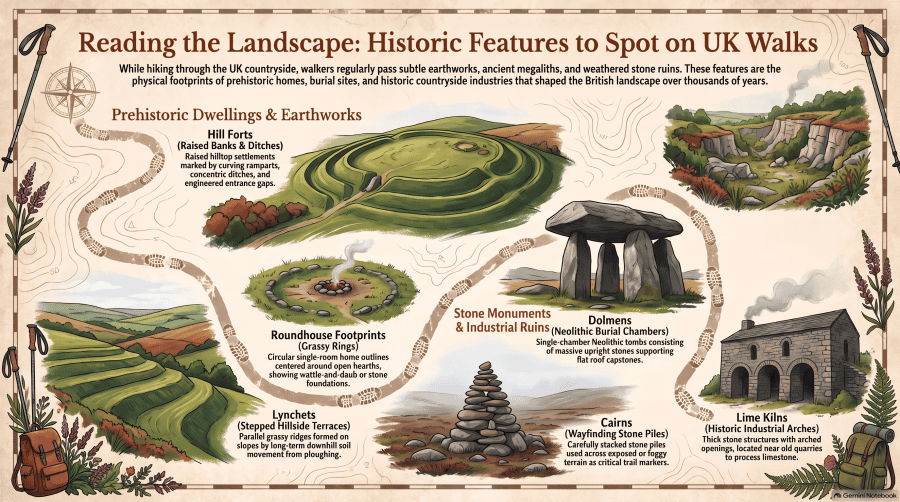
1. Cairns (Trail-Marking Stone Stacks)
- What it is: A cairn (from the Scottish Gaelic word carn) is a carefully constructed pile of rocks.
- What to look for: You’ll spot these stacks on mountain summits, rocky ridges, and open moors where footpaths can easily get lost in fog or bad weather.
- Why it’s cool: Cairns have guided travellers for thousands of years. While historically used to mark ancient burial sites or memorials, hikers today rely on them as visual navigation beacons. Remember trail etiquette: enjoy looking at them, but don’t knock them down or build unnecessary new ones that could confuse other walkers! Read the full article: What is a Cairn? Understanding Its Purpose and Significance
2. Dolmens (Ancient Stone Portal Tombs)
- What it is: A dolmen is a prehistoric single-chamber tomb built from massive upright stones supporting a huge flat roof stone (called a capstone).
- What to look for: They look like giant, weathered stone tables sitting out in pastures, coastal areas, or moors.
- Why it’s cool: Built during the Neolithic period (New Stone Age), these structures served as communal burial chambers and ritual focal points. Standing next to one leaves you wondering how ancient humans moved multi-ton rocks without modern machinery! Read the full article: What Is a Dolmen? Exploring Ancient Burial Sites for Walkers
3. Hill Forts (Prehistoric Defended Settlements)
- What it is: A raised hilltop enclosure surrounded by deep ditches and massive earth or stone banks (ramparts).
- What to look for: High ridges or summits surrounded by distinct, curving grassy banks and terraced ditches.
- Why it’s cool: Built mostly during the Iron Age, these were ancient social hubs and defended settlements where tribes lived in roundhouses, traded goods, and took shelter during times of threat. Walking across sites like Maiden Castle gives you incredible views and a real sense of history. Read the full article: What Is a Hill Fort? UK History, Features, and Top Sites
4. Lime Kilns (Industrial Ruins in the Countryside)
- What it is: Heavy stone structures built into hillsides or near waterways that were used to burn limestone into quicklime.
- What to look for: Thick stone walls, arched openings at the base (draw holes), and loading tracks or ramps leading up to the top.
- Why it’s cool: Before modern cement, lime kilns heated limestone to over 900°C to produce quicklime for traditional building mortar and agricultural fertilizer. Discovering these industrial ruins tucked along forest paths or canal paths offers a glimpse into local heritage. Read the full article: What Is a Lime Kiln? Discovering Britain’s Industrial Ruins on a Walk
5. Lynchets (Historic Hillside Terraces)
- What it is: Stepped grassy terraces running horizontally across sloping hillsides.
- What to look for: Long, parallel banks (risers) separating flat strips of ground (treads) that create a staircase effect on hills.
- Why it’s cool: Lynchets were formed over centuries of repeated ploughing and soil movement downhill, allowing historic farmers to cultivate steep slopes. They are especially common across southern England’s chalk downlands like the South Downs and Salisbury Plain. Read the full article: What Are Lynchets? Understanding Historic Hillside Terraces
6. Roundhouses (Ancient Circular Homes)
- What it is: Circular, single-room homes built around a central open fireplace, used across Britain from the Bronze Age through the Iron Age.
- What to look for: Subtle grassy rings, stone foundations (hut circles), or ring-ditches on moors and hillsides.
- Why it’s cool: Roundhouses were smartly engineered homes built with conical thatched roofs that shed harsh winds far better than square buildings. Seeing their outlines on a hike shows you exactly where prehistoric families lived, cooked, and worked thousands of years ago. Read the full article: Roundhouse Explained: Life and Architecture in Ancient Britain
7. Standing Stones (Prehistoric Megaliths & Circles)
- What it is: Large upright stones set into the ground, ranging from single isolated rocks (menhirs) to full stone circles.
- What to look for: Solo standing monoliths or rings of upright stones set into the landscape.
- Why it’s cool: Dating back to the Neolithic and Bronze Age (3000 to 2000 BC), these megaliths served as giant astronomical calendars for tracking solstices, spaces for seasonal feasting, and ritual gathering points. Famous UK sites include Stonehenge, Avebury, and the Callanish Stones. Read the full article: Standing Stones 101: History, Hype, and UK Mysteries
Wrapping Up: Ready to Hit the Trails?
Taking up hiking is about so much more than just getting your daily steps in – it’s like stepping into an open-air museum where you can read the history of the landscape right under your feet. Whether you’re standing on the windswept ramparts of an Iron Age hill fort or passing a centuries-old farming terrace, every trail in the UK has a story to tell.
As you head out on your outdoor adventures, remember a few quick rules of trail etiquette:
- Respect the ruins: Stick to established public footpaths and avoid climbing on fragile stone walls, dolmens, or industrial arches so these historical sites stay preserved for everyone.
- Practice cairn etiquette: Admire existing waymarker cairns that help guide fellow hikers, but avoid building unnecessary new rock stacks or dismantling historic stone piles, which can disrupt local wildlife habitats and confuse navigate paths.
- Stay safe on the path: Always check the weather forecast, pack appropriate waterproof clothing and footwear, and keep a map or route app handy before setting off.
Now grab your rucksack, lace up your boots, and see how many of these 7 landmarks you can spot on your next walk!
Which landmark are you most excited to hunt for on the trail?
Turn your UK hikes into history hunts! Learn to spot 7 iconic outdoor landmarks like standing stones, dolmens, and cairns with our beginner’s guide
Recent Posts
What Is a Lime Kiln? Discovering Britain’s Industrial Ruins on a Walk
When you’re out walking in the British countryside, you might come across a curious stone structure tucked into a hillside, standing beside an old quarry or hidden among the trees near a disused...
When you're out hiking across the British countryside, you might notice unusual steps running across a hillside. They can look like long, grassy banks, shallow hollows or a series of terraces cut...