

Table of Contents
Some links on posts are affiliate links and will earn us a commission from qualifying purchases
Long before maps, towns, or smartphones existed, ancient communities were hauling massive rocks into fields and setting them upright – these are known as standing stones. Spanning from single isolated stones (menhirs) to full-blown stone circles, most of these structures were built during the Neolithic (New Stone Age) and Bronze Age (roughly 3000 to 2000 BC).
Whether they were built for ancient raves, ancestor worship, or tracking the stars, these megaliths still dominate the UK landscape today. Here is the lowdown on why they’re here, how they were built, and where to find the best ones.
The Quick Highlights
- When? Built mostly between 3000 BCE and 2000 BCE, bridging the transition from early farming communities to the discovery of metalwork.
- Why? Rituals, massive seasonal gatherings, ancestor memorials, and solar/lunar astronomical calendars.
- What type? Everything from single solo rocks to massive complex landscapes featuring avenues, henges, and burial mounds.
- Where? Heavily concentrated in Wiltshire, the Scottish Highlands and Islands, Wales, and across Ireland.
- The Vibe? A fascinating mix of hard archaeological science, ancient engineering feats, and weird local folklore.
Why Did They Build Them?
Nobody left behind a written manual, but archaeologists agree the stones served three main overlapping purposes across prehistoric Britain:
- Massive Ceremonies & Feasts: Think of them as the original community hubs. Tribes travelled huge distances to gather, feast, trade cattle, and socialise. Excavations near Stonehenge show people were travelling from as far away as Scotland for winter solstice gatherings.
- Ancestor Worship & Burials: Many stones sit right next to long barrows, chambered tombs, or hold cremated human remains directly beneath them. Setting massive rocks in place was a way to honour the dead and stake a permanent claim on tribal territory.
- Sky-Watching & Calendars: Archaeoastronomy shows deliberate alignments with the sky. Sites align perfectly with the summer or winter solstices and complex lunar cycles like lunar standstills. These acted as giant stone calendars, letting farmers know exactly when to plant crops or prepare for winter.
How on Earth Did They Build Them?
Without cranes, trucks, or iron tools, building these monuments was an absolute feat of organisation and engineering:
- Quarrying & Transporting: Builders moved rocks weighing up to 30 tons using wooden sledges, rollers, A-frame timber cranes, and river rafts. Bluestones at Stonehenge were moved over 140 miles all the way from the Preseli Hills in Wales!
- Precision Shaping: They shaped hard stone like sarsen by hammering it with flint or stone mauls. At Stonehenge, they took woodworking techniques and used them on rock, carving mortise-and-tenon joints to lock the top lintels firmly onto the uprights.
- Erecting the Stones: Teams dug deep pits with timber-reinforced ramps, slid the base of the stone in, and pulled it upright using heavy ropes and wooden scaffolding before backfilling the hole with rubble.
Decoding the Styles: What Are You Looking At?
| Structure Type | What It Actually Is | Key Feature | Best Example |
| Stone Circle | Upright stones set in a ring or oval. Used for gatherings, celestial tracking, and ceremonies. | Often aligned with solstices or surrounding landscapes. | Avebury (Wiltshire) & Ring of Brodgar (Orkney) |
| Menhir (Single Stone) | A single tall rock standing alone. Used as boundary markers, trail points, or memorials. | Can reach up to 7+ metres in height. | Rudston Monolith (East Yorkshire) |
| Dolmen | Prehistoric portal tomb: upright stones topped with a flat roof stone cap. | Originally covered in earth; served as burial chambers. | Pentre Ifan (Wales) & Poulnabrone (Ireland) |
| Henge | An earthwork consisting of a circular bank and ditch. (Note: Not all henges have stones!) | Ditch sits inside the bank, meaning it was built for ritual, not defence. | Arbor Low (Derbyshire) |
The Big Four UK Sites to Know
- Stonehenge (Wiltshire): The world’s most iconic circle. Famous for its massive lintels, bluestones brought from Wales, and legendary alignment with the midsummer sunrise and midwinter sunset.
- Avebury (Wiltshire): Bigger in scale than Stonehenge! It features the largest stone circle in Europe, encloses a whole village, and connects to West Kennet Avenue – a 1.5-mile path of paired stones.
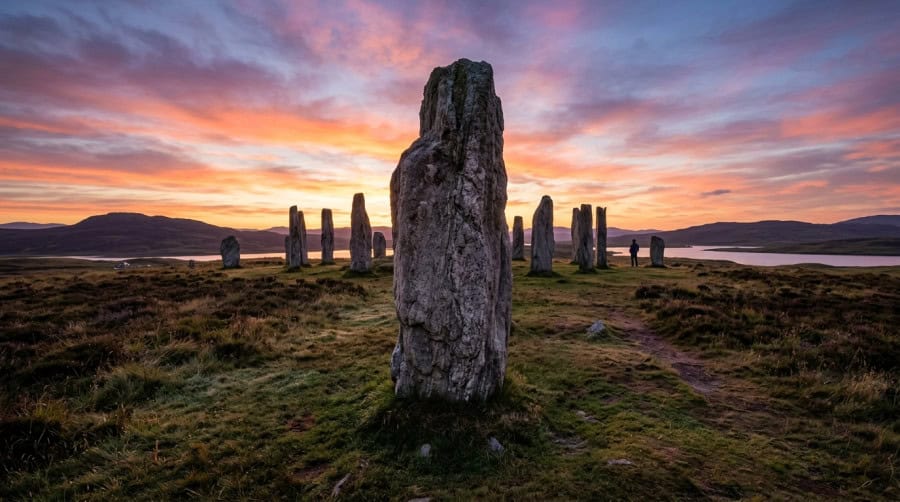
- Callanish Stones (Isle of Lewis, Scotland): A dramatic cross-shaped layout of pale Lewisian gneiss surrounding a central monolith and chambered tomb. Built around 3000 BC, it has major otherworldly vibes.
- The Ring of Brodgar (Orkney, Scotland): A massive 104-metre wide circle set in a natural amphitheatre between two lochs. Part of the UNESCO “Heart of Neolithic Orkney” alongside Skara Brae and the Stones of Stenness.
Regional Variations in England, Scotland, Wales, and Ireland
In England, big circles like Avebury and Stanton Drew stand near earlier henges and long barrows. You’ll also see smaller flattened or oval rings such as Stanton Moor and the nearby Nine Ladies. Coastal Cornwall contains notable examples like Boscawen‑Un and other Bronze Age rings.
Scotland concentrates circles in Orkney and Aberdeenshire. The Ring of Brodgar and the Stones of Stenness sit in a rich Orcadian cluster. In the far north you’ll find dense groups and many smaller megaliths carved from local bedrock.
Wales and Ireland show their own variety. Wales has fewer large stone circles but local oval and recumbent forms appear. In Ireland you’ll find many small ring-cairns and circles tied to burial practice; Drombeg and other south-west examples reflect this. Sites such as Trefignath on Anglesey show island-specific stone use and ritual layouts.
Myths vs. Reality
Ancient rocks naturally spark wild stories. Over the centuries, locals used folklore to make sense of how these giant stones appeared overnight:
- Frozen Dancers: Local legends across the UK claim stone circles were maidens, musicians, or knights turned to stone by church figures or magic for dancing or playing music on the Sabbath (e.g., The Merry Maidens in Cornwall or The Whispering Knights in the Cotswolds).
- Magic & Healing: People believed passing through holed stones (like Mên-an-Tol in Cornwall) could cure rickets, back pain, or boost fertility.
- The Modern Science: Today, archaeologists move beyond myth using non-invasive tech. LiDAR (laser scanning), ground-penetrating radar, and magnetometry allow researchers to map thousands of hidden underground postholes, burial pits, and timber structures without digging up a single blade of grass.
See the YouTube video above from julesdingle to see an example of a stone circle, and learn more about the history and how they are made.
Quick FAQs
What was the purpose of standing stones in prehistoric Britain?
Archaeologists think people used standing stones mainly for ritual, ceremonial and social activities. Many circles and single stones show alignments with the sun or moon, suggesting a role in marking seasons or important dates.
Some sites include burial evidence or nearby barrows, so stones could also mark graves or ancestral places. The exact meaning likely varied by region and age, and no single purpose fits every site.
Why are there so many standing stones in Scotland compared with other parts of Britain?
Scotland kept more visible megalithic remains partly because later land use caused less intensive clearance and rebuilding than in lowland England. The rocky, upland and coastal landscapes also preserved isolated monuments better.
Cultural choices mattered too: some Neolithic and Bronze Age communities in Scotland built distinctive types like recumbent stone circles. Concentrations on islands and in the Highlands reflect local traditions and available stone.
What is the difference between a standing stone, a stone circle and a henge?
A standing stone (or menhir) is a single large upright megalith set into the ground by people. It can stand alone or form part of a larger arrangement.
A stone circle is a ring of upright stones placed in a roughly circular layout. Circles often provided space for gatherings and ceremonies.
A henge is an earthwork: a circular bank and ditch enclosing a space. Some henges contain stone circles, but not all stone circles sit inside henges.
Which are the most famous standing stones and stone circles to visit in Scotland?
Callanish on Lewis is one of the best known, with a central circle and radiating rows of stones. Stenness and the Ring of Brodgar on Orkney form a distinctive Neolithic complex with large circles and nearby tombs.
Other notable sites include the Standing Stones of Stenness, the Grey Cairns of Camster, and various recumbent circles in Aberdeenshire. Each site offers different layouts and local history to explore.
Where can I find a reliable map or list of stone circles and standing stones in Scotland?
Historic Environment Scotland provides maps, site records and official descriptions for many monuments. You can use their online portal to search by region or monument name.
The CANMORE database (National Record of the Historic Environment) lists detailed entries and coordinates. Local council heritage pages and reputable guidebooks from established publishers also give practical maps and visitor details.
How many stone circles are there worldwide, and how does Britain compare?
Worldwide counts vary by definition, but Europe has hundreds of stone circles and other megalithic rings. Britain and Ireland together contain roughly 1,300 known stone circles, making the British Isles one of the richest regions for these monuments.
Other regions also have important concentrations, such as Brittany in France, parts of Iberia, Scandinavia, and some sites in Asia and Africa. Distribution reflects different cultural traditions and preservation conditions.
Why were Britain’s standing stones built? Explore the ancient history, wild legends, and top UK stone circles to visit in this simple guide
Recent Posts
You spot earth banks curving over a skyline and wonder what people once did up there. A hill fort is a raised, defended settlement - often a ring of banks, ditches and entrances - where communities...
Have you ever come across a carefully balanced stack of stones while hiking or exploring the outdoors? What is a cairn? Cairns are stone piles that serve various purposes across different...