

Table of Contents
Some links on posts are affiliate links and will earn us a commission from qualifying purchases
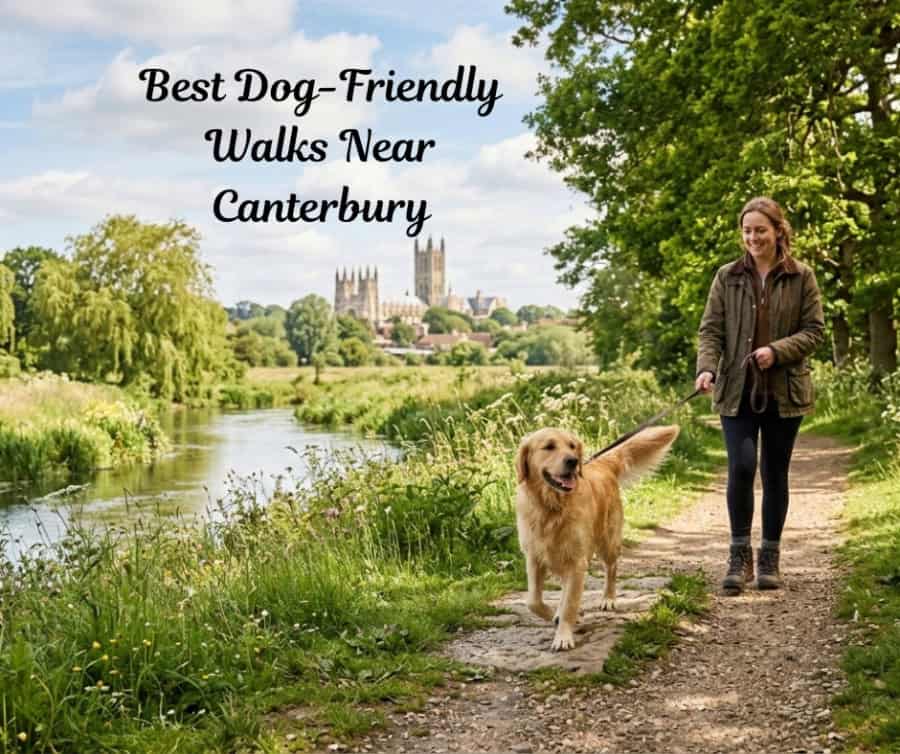
Finding the perfect spot to exercise your four-legged friend in East Kent can be a challenge with so many options. Whether you are looking for the salty air of the North Kent coast, the ancient shade of the Blean, or a historic stroll through a UNESCO World Heritage site, there are plenty of dog-friendly walks near Canterbury. This guide covers every trail, café, and seasonal rule you need to know for great Canterbury dog walking routes.
Quick Reference: Canterbury Dog Walks at a Glance
| Walk Name | Distance | Difficulty | Off-Lead | Parking | Best For |
| Blean Woods | 1–8 miles | Moderate | Yes | CT2 9DD | Ancient Woodland |
| Great Stour Way | 3 miles | Easy | Most | CT4 7HZ | Riverside Strolls |
| Reculver Towers | 3.5 miles | Easy | Limited | CT6 6SS | History & Views |
| Clowes Wood | 2.5 miles | Easy | Yes | CT5 3AR | Wildlife Spotting |
| Whitstable Beach | Variable | Easy | Seasonal | CT5 1DG | Coastal Air |
Woodland Walks Near Canterbury
Canterbury is enveloped by some of the most significant ancient woodlands in the UK, forming a lush green emerald ring around the historic city. These sprawling forests are part of the Blean Complex, which covers over 11 square miles. For a dog, these woods are a sensory masterpiece – a world of damp earth, scuttling squirrels, and deep shadows. For the owner, they offer a prehistoric silence that feels miles away from the bustling High Street. Whether you are navigating the crunch of golden leaves in October or seeking the cool, dappled canopy of a July afternoon, these woodland trails are the gold standard for Kentish dog walking.
Blean Woods Nature Reserve (West Blean & Thornden)
This is the “crown jewel” of local walking. Managed by the Kent Wildlife Trust, West Blean is a wild, expansive landscape that feels truly ancient. Recently, it has gained international fame for the Wilder Blean project, which introduced European Bison to the area to act as natural ecosystem engineers.
- The Experience: The trails here vary from wide, gravel-topped forestry tracks to narrow, winding “desire lines” that cut through dense ferns. It is a fantastic place for high-energy breeds like Collies or Spaniels who need the mental stimulation of varying terrain.
- The Bison Factor: While the bison are kept in a massive, fenced enclosure, you may catch a glimpse of them from the boardwalks. When walking near the enclosure, it is vital to keep your dog on a short lead to avoid distressing the herd.
- Distance: Various (Circular routes from 1 to 8 miles).
- Duration: 1–4 hours depending on the loop.
- Difficulty: Moderate (Expect some muddy hollows and uneven roots).
- Parking Postcode: CT2 9DD (Main car park off Thornden Wood Road).
- Off-Lead: Yes, in most areas, but keep dogs under close control near grazing Konik ponies and Iron Age pigs.
- Best Season: Autumn for the spectacular fungi and deep ochre colors.
- Nearest Café: Rough Common Village or a short 10-minute drive into the city center for a coffee at Garage Coffee.
Clowes Wood, Tyler Hill
Located just north of the University of Kent, Clowes Wood offers a more structured, yet equally beautiful, walking experience. It is a unique hybrid of ancient broadleaf woodland and commercial pine plantation, giving it a distinct “Scandi-forest” feel in certain sections.
- The Experience: This is a favorite for local “dog socialites.” The main circular route is broad enough for several dogs to run together without crowding other walkers. If you visit at dusk in the spring, you might hear the mechanical “churr” of the Nightjar, a rare bird that migrates here from Africa.
- Terrain: The ground here is generally firmer than West Blean, making it a better choice during the “shoulder seasons” when other woods become impassable mud baths.
- Distance: 2.5 miles (Main loop).
- Duration: 1 hour.
- Difficulty: Easy (Well-maintained timber extraction tracks).
- Parking Postcode: CT5 3AR (Free car park located off Radcliffe Road).
- Off-Lead: Yes, excellent visibility makes it safe for dogs with moderate recall.
- Best Season: Summer evenings for wildlife spotting or Frosty Winters for the pine scents.
- Nearest Café: The Tyler’s Kiln is a very dog-friendly pub just down the road, featuring a dedicated “dog station” with water and treats.
Hamstreet Woods
Technically a short drive toward the Ashford border, Hamstreet Woods is a National Nature Reserve and arguably the most beautiful spot in the county during the spring. It is a remnant of the once-mighty Forest of Anderida that covered the Weald.
- The Experience: The wood is famous for its “hornbeam coppice” structure. For dogs, the density of the undergrowth provides endless “search and find” opportunities. There are three waymarked trails (Green, Red, and Blue), with the Blue trail being the most comprehensive.
- The Bluebell Phenomenon: In late April, the forest floor transforms into a literal sea of violet. It is breathtaking, but please keep your dog on the designated paths during this time—bluebells are fragile and take years to recover from being trampled.
- Distance: 2-mile trek (Connects to the longer Saxon Shore Way).
- Duration: 1.5 hours.
- Difficulty: Moderate (Can be slippery on the clay-heavy soil).
- Parking Postcode: TN26 2HH.
- Off-Lead: Yes, but be wary of the deep ponds located in the center of the woods.
- Best Season: Late April/Early May for the Bluebells.
- Nearest Café: The Cosy Kettle in Hamstreet village—they are famous for their cakes and welcoming paws.
Riverside & Countryside Walks Near Canterbury
If your dog is a “water baby” or simply enjoys the wide-open expanse of a traditional English meadow, the riverside trails surrounding Canterbury are unbeatable. The city is built around the River Stour, which splits into two channels as it passes through the historic centre. Following these waterways out of the city allows you to transition from urban stone to lush, emerald-green marshlands in a matter of minutes. These routes are generally flatter than the woodland trails, making them ideal for older dogs, puppies, or owners looking for a gentle, rhythmic stroll without the vertical climb of the North Downs.
Chartham to Canterbury (River Stour Walk)
This is widely considered the quintessential East Kent riverside walk. It mirrors the railway line and the river, offering a peaceful corridor through the Great Stour valley. The path is a mix of hard-packed gravel and grassy embankments, winding through orchards and past traditional oast houses.
- The Experience: For dogs, this walk is a sensory delight. The air is thick with the scent of wild mint and river weeds. There are several safe “dipping spots” where the bank levels out, allowing your dog to splash in the shallow, clear chalk stream water. It is a fantastic route for social dogs, as you are likely to meet many local walkers heading into the city for a Saturday morning coffee.
- Trail Tip: If you don’t want to walk the full 6-mile round trip, you can take your dog on the train! Southeastern trains are dog-friendly, and the journey between Canterbury West and Chartham takes less than 10 minutes.
- Distance: 3 miles (One way).
- Duration: ~1.5 hours.
- Difficulty: Easy (Predominantly flat).
- Parking Postcode: CT4 7HZ (Chartham Station) or CT1 3XJ (Canterbury end).
- Off-Lead: Yes, in the wide meadow sections, but be wary of cyclists sharing the path.
- Best Season: Summer. The river breeze keeps the temperature down, and the dragonflies provide plenty of “sky-snapping” entertainment for curious pups.
- Nearest Café: The Artichoke in Chartham is a stunning 14th-century pub with a massive garden where dogs are treated like royalty.
Great Stour Way
The Great Stour Way is a dedicated multi-user path that forms part of the National Cycle Network Route 18. Because it is largely paved or surfaced with high-quality crushed stone, it is the most “all-weather” countryside walk in the Canterbury district.
- The Experience: Starting at Westgate Gardens—one of the most photographed parks in England—you follow the river out past Toddler’s Cove and into the Bingley Island nature reserve. This area is a mosaic of reed beds and wet woodland. While the path is popular with cyclists, the verges are wide, giving you plenty of room to step aside and let your dog sniff the hedgerows.
- Accessibility: This is the best choice for owners with limited mobility or those using “doggy strollers” for senior pets.
- Distance: 3 miles (Extends further toward Shalmsford St).
- Duration: 1 hour.
- Difficulty: Easy (Fully accessible).
- Parking Postcode: CT1 2BZ (Pound Lane) or CT1 3XJ (Whitehall Road).
- Off-Lead: Most sections are suitable for off-lead play, provided your dog doesn’t have a habit of chasing passing bicycles.
- Best Season: Winter. While the woods are bogged down in mud, the Great Stour Way stays clean and dry underfoot.
- Nearest Café: Refectory Kitchen on St. Dunstans St. is famous for its brunch and is exceptionally welcoming to dogs.
Grove Ferry & Stodmarsh Nature Reserve
For those who want a true “wilderness” feel, Grove Ferry and the adjacent Stodmarsh Nature Reserve offer a landscape of international importance. This is a Site of Special Scientific Interest (SSSI) and contains the largest reed beds in the South East of England.
- The Experience: The walk follows the much wider, deeper section of the Stour. You’ll see traditional riverboats and perhaps even the “Electric River Boat” tour passing by. The landscape is vast and sky-heavy, perfect for clearing the cobwebs.
- Wildlife Sensitivity: This is a crucial area for rare birds like the Bittern and Marsh Harrier. Unlike the other walks mentioned, the rules here are strict: dogs must be kept on a short lead at all times within the reserve sections to prevent them from disturbing ground-nesting species or the local cattle used for conservation grazing.
- Distance: 4 miles (Circular loop via the riverbank).
- Duration: 2 hours.
- Difficulty: Easy (Flat marshland, but can be windy).
- Parking Postcode: CT3 4BP (Grove Ferry Picnic Area).
- Off-Lead: No (Strictly lead-only within the reserve boundaries).
- Best Season: Late Autumn. The “Starling Murmurations” over the reed beds at dusk are a world-class natural spectacle.
- Nearest Café: The Grove Ferry Boat House has a sprawling riverside terrace. They even offer “Doggy Ice Cream” in the summer months.
See more on Stodmarsh Nature Reserve here
Coastal Dog Walks Near Canterbury
One of the greatest perks of living in or visiting Canterbury is its proximity to the North Kent Coast. Within a 15-to-20-minute drive, the landscape shifts from medieval stone and lush river valley to the bracing, salty air of the Thames Estuary. The coastline here is a patchwork of pebble beaches, dramatic clay cliffs, and historic promenades.
However, coastal walking with a dog in Kent requires a bit of “insider knowledge.” Many of the main swimming beaches have strict seasonal bylaws. To ensure you don’t end up with a fine, we’ve detailed exactly where you can roam free and where you need to keep your pup on a short lead.
Whitstable Beach & Tankerton Slopes
Whitstable is arguably the most dog-friendly town in the Southeast. Here, the “dog-is-king” mentality extends from the pebble shores to the boutique shops on Harbour Street.
- The Experience: For a truly varied walk, start at the Whitstable Harbour and walk east toward Tankerton Slopes. The Slopes are a vast expanse of tiered Victorian parkland overlooking the sea. On a clear day, you can see the Maunsell Sea Forts on the horizon. For dogs, the “Long Rock” area at the far end of the slopes is a dream; at low tide, the sea retreats to reveal “The Street”—a natural shingle bank that stretches half a mile into the ocean. It’s the closest your dog will ever get to walking on water!
- Seasonal Rules: From May 1st to September 30th, dogs are restricted from the main swimming beach (between the Harbour and The Street). However, the Tankerton Slopes themselves and the “Long Rock” marshland remain open to dogs year-round.
- Distance: 2–4 miles (Depending on how far you trek toward Hampton).
- Duration: 1–2 hours.
- Difficulty: Easy (Flat paths or grassy slopes).
- Parking Postcode: CT5 1DG (Gorrell Tank Car Park).
- Off-Lead: October–April (Total freedom); May–September (Slopes only).
- Best Season: Winter. There is nothing quite like a “Whitstable blow” followed by a bowl of mussels in a pub that welcomes damp dogs.
- Nearest Café: The Bubble at the bottom of the slopes is a local institution that always has water bowls ready.
Herne Bay Promenade & Beach
If you prefer a more structured, “classic” seaside stroll, Herne Bay is the place to be. The promenade is wide, flat, and lined with colorful beach huts and Victorian gardens.
- The Experience: The walk from the Clock Tower toward the Reculver direction is the most peaceful stretch. It transitions from a bustling pier environment to a rugged, natural shoreline. For dogs that prefer a solid surface under their paws rather than shifting pebbles, the concrete promenade is an excellent choice.
- The “Hampton” Secret: If you head west toward Hampton-on-Sea, you’ll find a much quieter stretch of coastline where the rules are more relaxed and your dog can enjoy a quiet swim away from the main tourist crowds.
- Distance: 3 miles (Promenade length).
- Duration: 1.5 hours.
- Difficulty: Easy (Completely flat and paved).
- Parking Postcode: CT6 5EJ (William Street).
- Off-Lead: Limited. Dogs must be on a lead on the promenade. Beach access is restricted in the central “Blue Flag” zones during summer.
- Best Season: Spring. The flower beds along the Waltrop Garden are in full bloom, and the air is fresh without the summer heat.
- Nearest Café: Makcari’s Parlour—they offer incredible gelato and are very accommodating to well-behaved dogs on their terrace.
Reculver Country Park & Towers
This is the most dramatic coastal walk in the Canterbury district. The “Twin Sisters” towers of the ruined 12th-century church stand as a landmark for miles.
- The Experience: This is a Site of Special Scientific Interest (SSSI) due to the eroding clay cliffs which are home to thousands of sand martins. The walk offers two distinct vibes: you can walk along the sea wall for a flat, breezy trek, or take the cliff-top paths for incredible views and more varied terrain for your dog to explore.
- History for Humans: While your dog sniffs the ancient Roman foundations of the fort (Regulbium), you can read the info boards about the “Bouncing Bomb” prototypes that were tested here during WWII.
- Distance: 3.5 miles (Circular).
- Duration: 1.5 hours.
- Difficulty: Easy to Moderate (The cliff paths involve some gentle inclines).
- Parking Postcode: CT6 6SS (Large pay-and-display car park).
- Off-Lead: Yes, in the designated country park meadows. However, keep your dog on a lead near the cliff edges for safety – the clay can be unstable!
- Best Season: Late Summer. The sea breeze is a lifesaver for dogs that struggle with the inland humidity.
- Nearest Café: HatHats Coffee at the Reculver visitor centre is award-winning and specifically designed to be a hub for walkers and their pets.
City Walks in Canterbury with Your Dog
Many visitors assume that a medieval walled city like Canterbury is too cramped for a proper dog walk. In reality, the “Green Gap” policy of the local council has preserved a stunning ring of riverside parks and heritage trails right in the shadows of the Cathedral. These walks are perfect for “social” dogs who enjoy a mix of sights, sounds, and smells, or for owners who want to combine a morning stroll with a bit of world-class history.
The Queen Bertha Walk (UNESCO Heritage Trail)
Named after the 6th-century Queen of Kent who helped bring Christianity to England, this walk is a journey through time. It links the three sites that comprise Canterbury’s UNESCO World Heritage status.
- The Experience: You start at the Cathedral Precincts (where dogs are welcome on leads), pass through the ancient Queningate (a Roman gateway), and head toward the ruins of St Augustine’s Abbey. The walk concludes at St Martin’s Church, the oldest church in the English-speaking world still in use. For a dog, the highlights are the hidden green pockets along the city walls and the many historic alleyways that offer a cooler microclimate on hot days.
- Heritage Note: While dogs cannot enter the interior of the Abbey or the Church, the external views and the surrounding public pathways provide a magnificent backdrop for a lead-walk.
- Distance: 1.5 miles (Linear).
- Duration: ~1 hour (depending on how often you stop to read the heritage plaques).
- Difficulty: Easy (Paved city pavements and level park paths).
- Parking Postcode: CT1 1DU (Queningate) or CT1 2BZ (Pound Lane).
- Off-Lead: No. This is a city-center route with road crossings; keep your pup on a lead.
- Best Season: Year-round. The city is particularly magical in winter when the Christmas lights are up.
- Nearest Café: The Goods Shed near Canterbury West station is a dog-friendly farmers’ market and restaurant with incredible local produce.
Westgate Gardens & Dane John Gardens
If you are looking for a shorter “leg-stretcher” without leaving the city, these two parks are the lungs of Canterbury.
- Westgate Gardens: One of the oldest public parks in England, it follows the River Stour as it flows under the 600-year-old Westgate Towers. It features an enormous Oriental Plane tree (over 200 years old) that dogs love to investigate.
- Dane John Gardens: Located alongside the city walls, this park features a massive mound (an old Roman cemetery turned medieval motte) that provides a great “hill sprint” for energetic dogs and a panoramic view of the Cathedral for their owners.
- Distance: 0.5 – 1 mile.
- Difficulty: Very Easy.
- Parking Postcode: CT1 2BZ.
- Off-Lead: Allowed in designated areas, but be mindful of the many squirrels!
The Crab & Winkle Way (Canterbury to Whitstable)
For those looking for a “Big Day Out,” the Crab & Winkle Way route is the definitive North Kent trek. It follows the path of the pioneer railway line that opened in 1830—the first in the world to offer a regular passenger service. Today, it is a flagship “Rails to Trails” route.
- The Experience: The trail begins with a steady, heart-pumping climb out of Canterbury through the University of Kent campus. As you crest the hill, the urban landscape disappears, replaced by the deep silence of Clowes Wood. The path is a mix of woodland tracks, open fields, and old railway embankments. It is a fantastic “energy-burner” for dogs that need a long, sustained hike.
- The “Half-Way” Landmark: Look out for the Winding Pond in the middle of the woods. It once provided water for the stationary steam engines that pulled the trains up the steep incline. Today, it’s a tranquil spot where dogs can pause for a drink (though keep them away from the sensitive reed beds).
- Logistics: Most walkers do this as a one-way trip. The “Triangle” bus service between Whitstable and Canterbury is dog-friendly and runs every 15 minutes, making it easy to get back to your car.
- Distance: 7.5 miles (One way).
- Duration: 3–4 hours.
- Difficulty: Moderate (The initial climb from Canterbury is significant; the rest is gently undulating).
- Parking Postcode: CT2 7AS (Canterbury West Station) or CT5 1AB (Whitstable Station).
- Off-Lead: Yes, once you are clear of the University campus and into the woodland/agricultural sections.
- Best Season: Autumn. The blackberries along the old railway embankments are legendary, and the canopy provides a golden tunnel of light.
- Nearest Café: Windy Corner Store in Whitstable is the traditional “finish line” for walkers. It’s a bohemian deli-café where the floor is usually 50% dog!
See more on Crab & Winkle Way here
Seasonal Guide – Best Canterbury Dog Walks by Time of Year
| Season | Recommended Walk | Why? |
| Spring | Hamstreet Woods | The scent of wild garlic and the floor-to-ceiling bluebells are a sensory peak for both dog and human. |
| Summer | Great Stour Way | The river acts as a natural air conditioner. Plenty of “paws-in” spots to keep your dog from overheating. |
| Autumn | Blean Woods | The “Master of Aromas.” The damp earth and rotting leaves provide a complex scent-map that will keep a dog’s nose busy for hours. |
| Winter | Whitstable Beach | With the summer tourists gone and the bans lifted, the beach becomes a giant, salty playground. |
Dog-Friendly Pubs & Cafés Near Canterbury Walks
After a long trek through the Blean or a breezy stroll along the Stour, there is nothing quite like a “paws-under-the-table” pitstop. Canterbury and its satellite villages are exceptionally welcoming to dogs, often providing specialized menus, water stations, and even “doggy beer” (non-alcoholic broth).
The Best “Post-Walk” Spots
| Pub/Café | Location | Nearby Walk | Why Dogs Love It | Highlights |
| The Victoria Inn | Munday Bois | Blean Woods | Huge enclosed garden | Open fires and free treats at the bar. |
| The Artichoke | Chartham | River Stour Walk | Riverside terrace | 14th-century charm with plenty of floor space. |
| The Old Neptune | Whitstable | Whitstable Beach | Literally on the beach | The iconic “Neppy” allows dogs inside and out. |
| The Parrot | Canterbury | City Heritage Walk | Historic atmosphere | Medieval architecture with a hidden courtyard. |
| The Tyler’s Kiln | Tyler Hill | Clowes Wood | Dedicated dog station | Voted one of the most dog-friendly pubs in Kent. |
| Garage Coffee | Canterbury | Great Stour Way | Social atmosphere | Expert roasts and plenty of space for pups to rest. |
The “Dog-Friendly” Etiquette in Canterbury
While Kentish hospitality is warm, following a few local “unwritten rules” ensures we keep these spaces open to our furry friends:
- The “Dry-Off” Rule: If you’ve just come from a muddy stint in the Blean or a swim in the Stour, keep a towel in the car. Most pubs appreciate a quick wipe-down before you head inside.
- Booking Ahead: On weekends, Canterbury’s pubs get packed. Mention you have a dog when booking so they can allocate a spacious corner table.
- The “Settled” Dog: High-traffic spots like The Goods Shed are best for dogs that can settle quietly under a table while you eat.
Practical Tips for Dog Walking Near Canterbury
To rank #1, a guide must solve the user’s problems before they happen. Here is the essential “Pre-Walk Checklist” for navigating the Garden of England.
1. Navigation & Parking Tech
Canterbury’s city center and rural hotspots have moved almost entirely to digital parking.
- The App to Have: Download RingGo before you leave home. Signal can be patchy in the depths of West Blean or at Reculver.
- Postcode Precision: Use the postcodes provided in this guide, but keep an eye out for “brown signs” as you approach; some rural car parks are tucked away down narrow single-track lanes (especially near Clowes Wood).
2. Seasonal Safety: Ticks & Adders
- Tick Alert: The long grass and bracken in the Blean Woods and Hamstreet Woods are prime territory for ticks from March to October. Always run a tick-comb through your dog’s coat after a woodland walk.
- Adders: Britain’s only venomous snake, the Adder, can occasionally be found basking on the sunny, chalky banks of the North Downs Way or the coastal paths at Reculver. They are shy and rarely bite unless stepped on, but keep your dog on a lead if you are walking through thick heather or gorse in mid-summer.
3. The “Livestock” Reality
Kent is a working landscape. Even if a field looks empty, it may be used for “conservation grazing.”
- The Blean Bison: You are unlikely to meet a bison face-to-face as they are in a massive enclosure, but you will encounter Konik ponies and Iron Age pigs. These animals are semi-wild; keep your dog at a respectful distance.
- Orchard Ettiquette: Many walks (like Chartham) pass through commercial apple and cherry orchards. While tempting, do not let your dog forage for fallen fruit, as apple seeds and cherry stones can be toxic in large quantities.
Frequently Asked Questions
Are dogs allowed in Canterbury Cathedral?
Dogs are not permitted inside the Cathedral building itself (unless they are assistance dogs). However, they are welcome to explore the beautiful Cathedral Precincts and grounds provided they are kept on a lead.
Where can dogs swim near Canterbury?
The Great Stour Way has several shallow entry points near Chartham. For salt water, the “Long Rock” area between Whitstable and Herne Bay is ideal for doggy paddling.
Are there seasonal dog bans on Whitstable beaches?
Yes, from May 1st to September 30th, dogs are restricted from the main family beaches. They remain welcome at “Long Rock” and on the Tankerton Slopes year-round.
Can I take my dog on the bus in Canterbury?
Yes, Stagecoach buses in Kent generally allow dogs as long as they are well-behaved and kept on a lead.
What is the best dog walk near Canterbury for a rainy day?
The Great Stour Way is your best bet. Because it is a paved cycle path, you avoid the heavy clay mud that characterizes the local woods in winter, keeping both your boots and your dog’s paws relatively clean.
Are there any “lead-only” dog walks near Canterbury?
Yes. Stodmarsh Nature Reserve is a strictly lead-only site due to its status as a premier bird-watching wetland. This is to protect ground-nesting birds and sensitive wildlife.
Where can I find a dog-friendly beach near Canterbury in the summer?
While the main beaches in Whitstable and Herne Bay have summer bans (May–Sept), you can head to Long Rock (between Whitstable and Hampton) or Abbots Cliff further down the coast for year-round off-lead fun.
Is there a vet available for emergencies near these walks?
Canterbury has several excellent 24-hour veterinary hospitals, including Barton Veterinary Hospital (CT1 1PZ) and Vets Now Canterbury (CT2 7HG), which provides out-of-hours emergency care.
Which walk is best for reactive dogs?
Clowes Wood is excellent because the paths are very wide, allowing you to see other walkers from a long distance and give your dog plenty of “decompression space.”
The Countryside Code for Dog Walkers
To ensure these beautiful spaces remain open to everyone, we follow the Countryside Code:
Leave No Trace: Always bag waste and take it to a bin. “Sticking and flicking” is not acceptable in SSSI nature reserves like the Blean.
Protect Wildlife: During nesting season (March–August), keep dogs on leads in woodland and heathland to protect the Nightjar and Sky Lark.
Respect Farmers: If you encounter sheep or cattle, put your dog on a short lead immediately, regardless of how good their recall is.
Be Considerate: Not everyone loves dogs. Yield to cyclists on the Great Stour Way and keep your dog from jumping on other walkers.
Useful Links
Discover 12 of the best dog-friendly walks near Canterbury, Kent — with parking, difficulty ratings, off-lead areas, and dog-friendly pubs. Updated 2026.
Recent Posts
Kent, often referred to as the "Garden of England," is a county known for its stunning landscapes, from rolling countryside to dramatic coastlines. Situated in the southeast of England, Kent offers a...
Kent, located in Southeast England, is renowned for its charming countryside and stunning landscapes. The county is a haven for nature enthusiasts and outdoor lovers, with a range of activities to...