

Table of Contents
Some links on posts are affiliate links and will earn us a commission from qualifying purchases
Most of us set off on a walk expecting a good day outdoors. We’ve checked the weather forecast, packed a sandwich, pulled on our walking boots and planned a route that should get us home in time for tea.
But have you ever stopped to think about what would happen if something went wrong?
A twisted ankle, a sudden change in weather, a missed turning or simply taking longer than expected can turn an enjoyable countryside walk into a much more difficult experience. During the summer, these situations might be little more than an inconvenience. In winter, with shorter days, colder temperatures and potentially challenging conditions, the consequences can be much more serious.
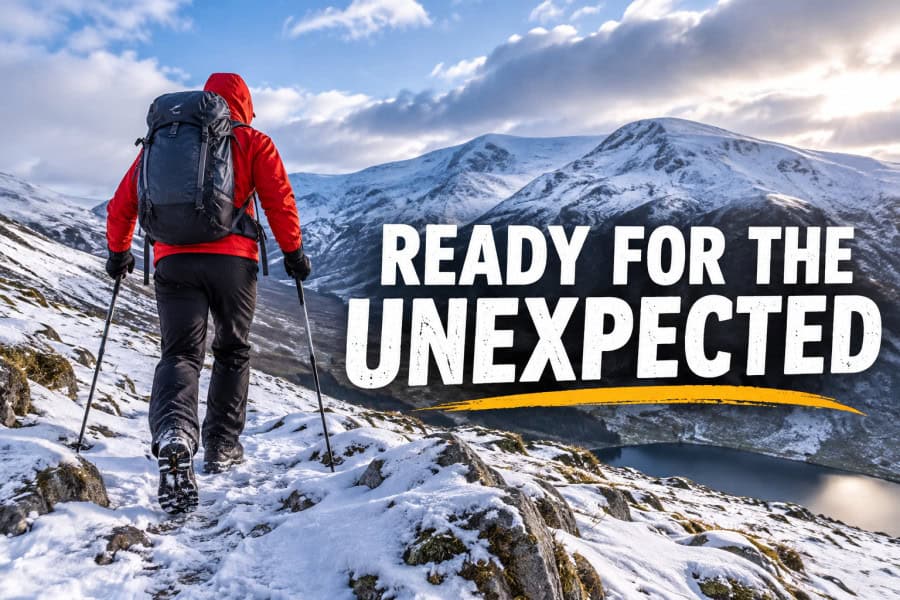
That’s the message behind Mountain Rescue England and Wales’ Ready for the Unexpected campaign.
The campaign encourages walkers to think ahead, carry the right equipment and understand how quickly circumstances can change when we’re out in the hills and countryside.
It’s advice worth taking seriously, whether you’re planning a challenging mountain hike or a relatively straightforward walk across your local countryside.
Here’s how to prepare yourself and your rucksack for those occasions when a walk doesn’t quite go to plan.
Why winter walking requires extra preparation
Winter can be a wonderful time to explore the British countryside. Frost-covered fields, quiet woodland paths and crisp views across the hills offer some of the most rewarding walking experiences of the year.
However, winter also reduces the margin for error.
There are several reasons why a walk that seems straightforward in October or November can become more challenging as the season progresses.
Shorter daylight hours: It’s surprisingly easy to underestimate how quickly darkness arrives. A walk that takes an hour longer than expected could leave you navigating unfamiliar paths in the dark.
Changing weather: Conditions can deteriorate quickly, particularly in exposed areas and on higher ground. Rain, strong winds, mist, snow and falling temperatures can all affect your ability to complete a route safely.
Slippery paths: Mud, wet leaves, frost and ice increase the likelihood of slips and falls. Even familiar paths can become much more difficult underfoot.
Cold and wet conditions: If you become injured or exhausted and have to stop walking, your body can lose heat quickly. Being wet, exposed to wind and unable to move around makes the situation worse.
Navigation difficulties: Poor visibility can make it harder to recognise landmarks and follow a route. Paths that are obvious in summer may be much less straightforward in mist or darkness.
The important thing to remember is that an emergency doesn’t always start with a dramatic accident. Sometimes it’s a relatively minor problem that becomes more serious because of the conditions around you.
The 12 essentials every hiker should consider carrying
You don’t need to spend a fortune on specialist equipment or fill a huge rucksack with survival gear. However, there are some basic items that could make a considerable difference if your walk takes an unexpected turn.
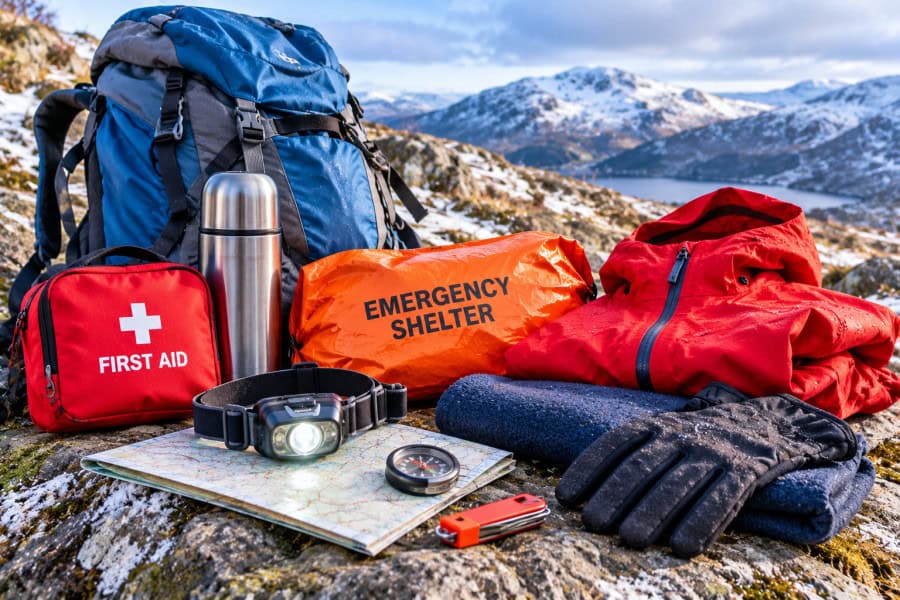
Here are 12 things worth considering before your next hike.
1. A waterproof jacket and trousers
British weather is notoriously unpredictable, and even a promising forecast shouldn’t encourage you to leave your waterproofs at home.
A decent waterproof jacket will help protect you from rain and wind, while waterproof trousers provide additional protection when conditions become particularly wet.
Getting soaked several miles from your starting point is uncomfortable at the best of times. If you have to stop because of an injury or other problem, wet clothing can contribute to dangerous heat loss.
Choose lightweight waterproofs that pack away easily so they’re available whenever you need them.
2. An extra insulating layer
Your normal walking clothes might be perfectly adequate while you’re moving, but what happens if you have to stop?
A fleece, insulated jacket or another warm mid-layer can help maintain your body temperature if conditions deteriorate.
It’s worth remembering that your body produces less heat when you’re stationary. An extra layer that spends most of the walk in your rucksack could become one of your most valuable possessions if you have to wait for assistance.
During winter, I would always recommend carrying more warmth than you think you’ll need.
3. A warm hat and gloves
These are two relatively inexpensive items that can make a big difference to your comfort and safety.
Your hands and head can become uncomfortable surprisingly quickly in cold, windy conditions. If you’re forced to stop walking, having a warm hat and a spare pair of gloves available can help you stay comfortable.
Consider carrying a spare pair of gloves, particularly if your first pair gets wet.
They take up very little room in a rucksack and could prove extremely useful.
4. An emergency shelter or bivvy bag
If there’s one piece of equipment from the Mountain Rescue campaign that deserves particular attention, it’s the emergency shelter.
A lightweight emergency shelter, group shelter or bivvy bag can provide valuable protection if you become stranded or have to wait for help.
Wind and rain can make an already uncomfortable situation considerably worse. An emergency shelter helps protect you from the elements and retain body heat.
There are several options available, from inexpensive survival bags and blankets to lightweight shelters designed to accommodate two or more people.
Choose something appropriate for the type of walking you do and make sure you know how to use it before heading out.
It might spend months sitting at the bottom of your rucksack without being needed. But if the unexpected happens, you’ll be very glad it’s there.
5. A proper headtorch
One of the easiest mistakes to make during winter is relying on your mobile phone torch for illumination.
Your phone might provide enough light to find something in your rucksack, but it’s not a particularly good substitute for a proper headtorch.
A headtorch provides hands-free lighting, allowing you to navigate, negotiate uneven ground and deal with equipment while keeping both hands available.
More importantly, it saves your phone battery for navigation and emergency communication.
Choose a reliable model with sufficient brightness for your walking conditions and carry spare batteries or ensure it is fully charged before setting off.
Even if you have no intention of walking after dark, a headtorch is an essential part of a sensible winter walking kit.
6. A map and compass
Walking apps and GPS devices have made route navigation much easier, but they shouldn’t be your only means of finding your way.
Mobile phone batteries can run out, screens can become difficult to use in wet weather and mobile signal coverage isn’t guaranteed in remote areas.
A paper map and compass provide a reliable backup, provided you know how to use them.
For UK walkers, Ordnance Survey maps are an excellent resource for understanding footpaths, terrain, contours and surrounding features.
If you’ve never used a compass or taken a map-reading course, it’s worth learning the basics. Carrying a map is only useful if you know how to interpret it.
Think of digital navigation as a helpful tool rather than something to rely on completely.
7. A fully charged mobile phone and power bank
Your mobile phone is an important piece of safety equipment when walking.
It can provide access to digital maps, weather forecasts and emergency services, as well as allowing you to contact someone if your plans change.
Before leaving home:
- Fully charge your phone.
- Download any maps you might need offline.
- Make sure important emergency numbers are accessible.
- Consider switching to battery-saving settings.
- Carry a power bank for longer walks.
Remember that mobile coverage can be unreliable in some countryside and mountain areas. Don’t assume you’ll always be able to make a call from wherever you happen to be.
Mountain Rescue also recommends registering for the emergencySMS service if you have hearing or speech difficulties.
8. Extra food and water
It’s easy to pack enough food and drink for the walk you’ve planned but forget about the possibility of being out for several additional hours.
Carrying extra food and water is a simple precaution.
Energy bars, nuts, dried fruit and chocolate are convenient options that don’t take up much space. They can provide useful energy if your walk takes longer than expected.
Water is equally important. Although we might not feel as thirsty during colder weather, dehydration is still possible.
Consider carrying a little more than you expect to need, particularly if you’re walking somewhere remote or undertaking a longer route.
9. A basic first aid kit
A small first aid kit is something every regular walker should consider carrying.
You don’t need a huge medical bag, but a few carefully chosen essentials can help you deal with minor problems before they become more troublesome.
Useful items include:
- Plasters and blister dressings.
- Sterile wound dressings.
- Bandages.
- Medical tape.
- Antiseptic wipes.
- Disposable gloves.
- Any essential personal medication.
Blisters, minor cuts and grazes are among the more common problems walkers encounter. Having the right supplies available can make dealing with them much easier.
It’s also worth familiarising yourself with basic first aid rather than simply carrying a collection of items you don’t know how to use.
10. An emergency whistle
A whistle might seem like an old-fashioned piece of outdoor equipment, but it remains a very useful item.
If you become separated from your walking companions, injured or unable to attract attention by shouting, a whistle can help rescuers or other walkers locate you.
Mountain Rescue recommends a recognised distress signal of six long blasts in one minute, followed bya one-minute pause. Repeat the pattern until help arrives.
Keep your whistle somewhere accessible, such as attached to your rucksack strap, rather than buried at the bottom of your bag.
It’s lightweight, inexpensive and takes up virtually no space.
11. Microspikes or ice grips when conditions require them
If you’re planning to walk in areas where icy paths or frozen ground are likely, traction aids can be a useful addition to your equipment.
Microspikes or walking ice grips fit over suitable footwear and provide additional grip on icy surfaces.
They’re particularly useful for certain winter countryside and lower-level mountain walks, where icy paths can make ordinary walking boots less effective.
However, it’s important to understand their limitations. They aren’t a substitute for proper winter mountaineering equipment, experience or training.
Steep snow and ice-covered mountain terrain may require specialist equipment such as crampons and an ice axe, together with the skills to use them safely.
If you’re unsure about the conditions or your ability to deal with them, choosing a different route is often the better decision.
12. Walking poles
Walking poles aren’t essential for everyone, but they can provide additional balance and stability on uneven ground.
They’re particularly useful when negotiating muddy paths, steep descents, loose surfaces and some slippery sections of trail.
For older walkers or anyone who feels less confident on uneven terrain, poles can also provide additional support and help distribute some of the effort involved in walking.
They’re not a guarantee against falling, and they won’t make an unsuitable route safe. However, used correctly, they can be a worthwhile addition to your walking equipment.
Shop a list of items from Amazon.
Planning your walk: preparation starts before you leave home
Carrying the right equipment is important, but good preparation starts well before you put on your walking boots.
Mountain Rescue’s advice is built around a simple principle: understand what you’re taking on, check the conditions and be prepared to change your plans.
Here are five habits worth developing.
Check the weather forecast
Don’t just look at the general forecast for the nearest town.
If you’re heading into the hills, check conditions for the specific area you’re visiting. Pay attention to wind speed, temperature, rainfall, visibility and any warnings.
Remember that conditions at higher elevations can be very different from those in nearby towns and villages.
Understand your route
Know how far you’re walking, how much climbing is involved and what sort of terrain you can expect.
A 10-mile walk across relatively flat countryside is very different from a 10-mile mountain route involving steep ascents and descents.
Be realistic about your fitness, experience and walking speed.
Allow enough daylight
This is particularly important during winter.
Don’t plan a route that leaves you with only a small margin of daylight. Allow additional time for rest stops, photographs, navigation problems and unexpected delays.
If your walk is taking longer than expected, consider shortening the route rather than pressing on regardless.
Tell someone where you’re going
Let a friend or family member know your intended route, where you’re starting and approximately when you expect to return.
If your plans change, let them know.
This is a particularly sensible precaution when walking alone or exploring less familiar areas.
Have a plan B
Not every walk needs to be completed exactly as planned.
If the weather deteriorates, visibility becomes poor or you start to feel tired, be prepared to change direction, shorten your route or turn back.
Knowing when to abandon a walk is part of being an experienced and responsible hiker.
What happens when a minor accident becomes an emergency?
Imagine you’re walking along a remote countryside trail when you slip on a muddy descent and badly twist your ankle.
Initially, it might not seem like a major emergency. Perhaps you can sit down, take a moment and assess the injury.
But then you realise you can’t put any weight on your foot.
It’s getting colder, the afternoon light is fading and you’re several miles from the nearest road.
Suddenly, a relatively minor accident has become a much more difficult situation.
You might need to remain where you are for some time while waiting for assistance. Without warm clothing or emergency shelter, the risk of becoming cold and wet increases.
This is why Mountain Rescue places so much emphasis on carrying the right equipment.
The emergency shelter, spare clothing, food, water and headtorch that seemed unnecessary when you left home could now be extremely important.
It’s also worth remembering that attempting to walk out with a serious injury can sometimes make things worse.
Being prepared means having the equipment and knowledge to deal with the situation rather than making a difficult problem more dangerous.
What should you do if you get into trouble while hiking?
If you or someone in your walking party suffers an injury or becomes stranded, try to remain calm and assess the situation.
Your priorities should be:
- Assess the situation. Establish what has happened and whether anyone needs urgent medical attention.
- Find a safe position. Where possible, get out of the wind and rain without putting yourself or anyone else at further risk.
- Keep warm. Put on extra clothing and use your emergency shelter if necessary.
- Contact emergency services. If you need Mountain Rescue, dial 999 or 112 and ask for Police, then Mountain Rescue.
- Provide accurate information. Explain where you are, what has happened, how many people are involved and the nature of any injuries.
- Follow instructions. Once you’ve contacted emergency services, follow their advice and don’t move from your location unless instructed or remaining there would be unsafe.
If possible, have a map reference or accurate GPS location ready. This can make a significant difference when rescuers are trying to establish exactly where you are.
Mountain Rescue also advises keeping your phone available and conserving its battery.
Remember that calling for help isn’t something to feel embarrassed about. If you believe someone is in danger and needs assistance, make the call.
Do you need all this equipment for every walk?
One question worth asking is whether every walker really needs to carry all 12 items.
The answer depends on the type of walking you’re doing.
If you’re taking the dog around a familiar local footpath for an hour, your equipment requirements will be different from someone heading into the Lake District for a full day of winter hiking.
However, it’s worth developing some basic habits regardless of where you’re walking.
For a short countryside walk:
Carry a charged phone, suitable clothing, water, some food, basic first aid supplies and a means of navigating your route.
For a longer countryside hike:
Add waterproof trousers, spare warm clothing, a headtorch, emergency shelter, a power bank, map and compass, and additional food and water.
For a winter mountain walk:
You need to think much more carefully about your equipment, experience and the conditions. Specialist winter equipment may be necessary, including ice axe and crampons, but only if you have the knowledge and training to use them safely.
The important thing is to match your preparation to the conditions and the challenges of the route.
You don’t need to carry everything imaginable, but you should always consider what could happen if the walk takes longer than expected or something goes wrong.
Remember the people who come to your rescue
It’s easy to think of Mountain Rescue as a service that will come to our assistance if we get into trouble in the hills.
What is sometimes overlooked is that the people providing that service are volunteers.
Mountain Rescue England and Wales recorded 3,968 callouts during 2025, highlighting the considerable demand placed on rescue teams across England and Wales.
Behind every callout are people giving up their time to search for missing walkers, assist injured hikers and help those who find themselves in difficult situations.
They undertake specialist training, maintain equipment and remain available to respond when needed.
The Ready for the Unexpected campaign is therefore about more than simply encouraging walkers to buy a few extra items of outdoor equipment.
It’s also about reducing avoidable emergencies through better preparation and decision-making.
If you enjoy spending time outdoors, consider supporting your local Mountain Rescue team through fundraising or donations. Their work makes a huge difference to the walking and outdoor community.
Frequently asked questions
I’d add these eight questions at the end of the article, before or after the final thoughts.
1. What should I carry when hiking in winter in the UK?
At a minimum, carry suitable waterproof clothing, spare warm layers, food, water, a charged mobile phone, navigation equipment, a headtorch, a first aid kit and an emergency shelter. Adapt your equipment to the route and conditions.
2. What is the most important emergency equipment for hikers?
An emergency shelter is particularly valuable because it provides protection from wind and rain if you become stranded or injured. However, no single item replaces proper preparation.
3. Do I need an emergency shelter for walking?
For longer walks, remote routes and winter hiking, carrying a lightweight emergency shelter is strongly recommended. Even a simple bivvy bag can provide useful protection.
4. Is a mobile phone torch sufficient for winter walking?
No. A dedicated headtorch is a much better option. It provides hands-free lighting and preserves your phone battery for navigation and emergency calls.
5. What should I do if I get injured while hiking?
Assess the injury, keep warm, find shelter if possible and call 999 if you need assistance. Ask for Police, then Mountain Rescue.
6. How do I contact Mountain Rescue in the UK?
Dial 999 or 112, ask for Police and then request Mountain Rescue. Provide your location and details of the incident.
7. Should I carry a paper map if I use a walking app?
Yes. A paper map and compass provide an important backup if your phone battery runs out, your device fails or you lose signal.
8. How can I prepare for changing weather conditions?
Check a local weather forecast, understand the conditions along your route, carry appropriate clothing and allow sufficient time to complete your walk in daylight.
Final thoughts: enjoy your walks, but be ready for the unexpected
One of the great things about walking is its simplicity. You don’t need expensive equipment or complicated plans to enjoy a few hours exploring the British countryside.
But that doesn’t mean we should take our safety for granted.
A little preparation can make a considerable difference if something unexpected happens. Checking the weather, planning a realistic route, carrying extra clothing and having an emergency shelter in your rucksack are all sensible precautions.
Most of the time, you’ll never need to use your emergency equipment. Hopefully, it will remain tucked away in your rucksack for years.
But if the day comes when something doesn’t go to plan, you’ll be glad you took the time to prepare.
Discover 12 essential items every UK hiker should carry. Mountain Rescue’s winter walking advice will help you stay safe and prepare for the unexpected.
Recent Posts
When the temperature drops and the trails get muddy, the right hiking trousers can make all the difference. Winter hiking is about staying warm, dry, and comfortable while still being able to move...
Winter Hiking Clothing Tips: Stay Warm and Comfortable on the Trail
When winter arrives, many hiking trails become covered in snow and ice, creating a winter wonderland for hikers. However, hiking in cold weather requires a different approach to clothing. Wearing the...