
Table of Contents
Some links on posts are affiliate links and will earn us a commission from qualifying purchases
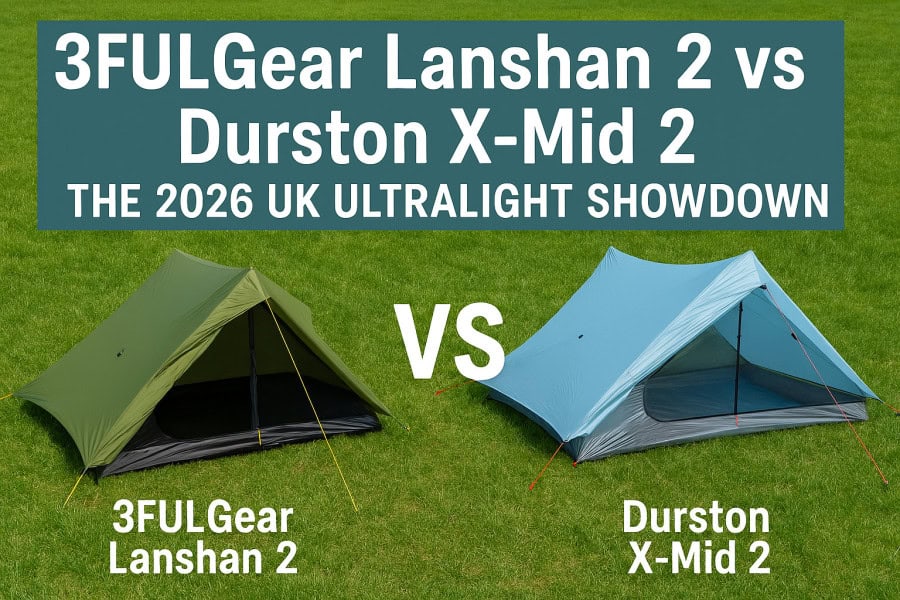
If you have spent any time on UK hiking forums or watching YouTube wild camping gear reviews recently, you will have noticed two names cropping up more than any others: the 3FULGear Lanshan 2 and the Durston X-Mid 2.
In 2026, the market for ultralight trekking pole tents has reached a fever pitch. On one side, we have the Lanshan 2 – often dubbed the “gateway drug” to ultralight hiking because of its incredible price point. On the other, we have the Durston X-Mid 2, a masterclass in geometric design that has gained a cult-like following for its performance in the unpredictable British weather.
But is the Durston really worth three times the price of the Lanshan? Or has the 2026 update to the Lanshan 2 closed the gap enough to make it the only tent most UK hikers will ever need? In this detailed comparison, we put these two titans head-to-head to help you decide which one deserves a spot in your rucksack.
Who Are These Tents For?
Before we dive into the specs, it is important to understand the philosophy behind each shelter.
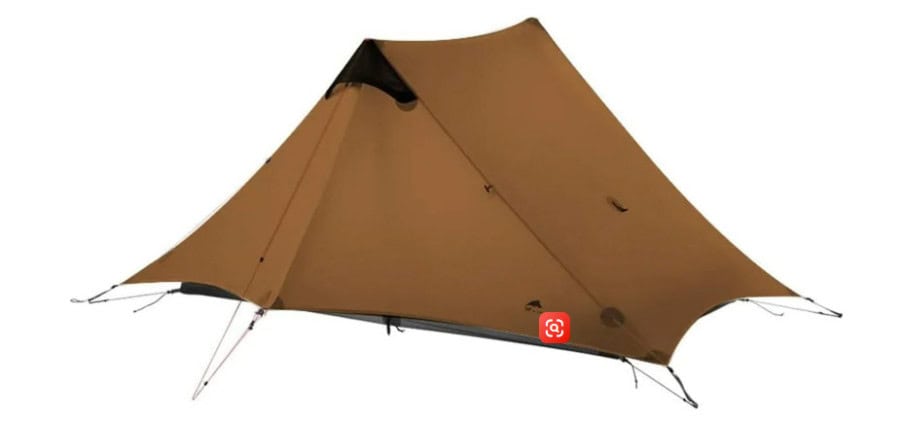
The 3FULGear Lanshan 2 is designed for the hiker who wants to drop their pack weight without dropping a month’s rent. It is a traditional A-frame design that has been refined over several years. The 2026 edition finally addresses long-standing complaints with factory-sealed seams and upgraded materials, making it a serious contender for three-season wild camping in the UK.
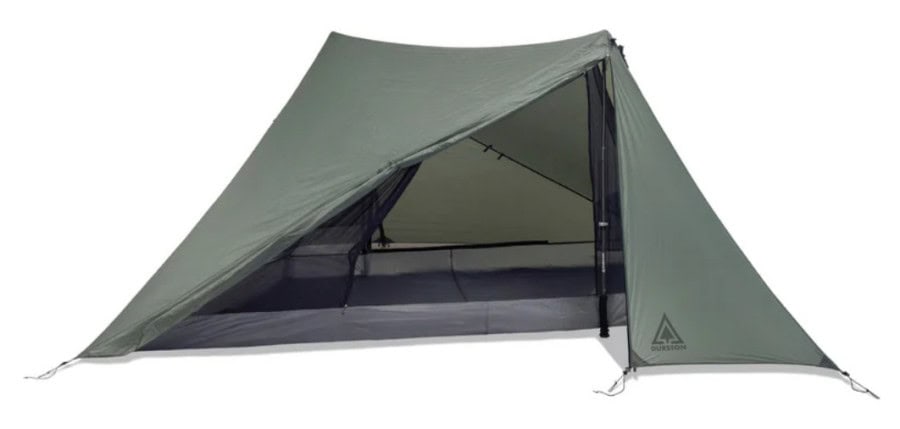
The Durston X-Mid 2 is for the gear enthusiast who prioritises design efficiency and weather protection. Created by Canadian hiker Dan Durston, its patented asymmetric shape is specifically engineered to solve the common problems of trekking pole tents: awkward pitching, sagging fabric, and cramped interiors. For many UK hikers facing the wind-battered fells of the Lake District or the Highlands, the X-Mid is seen as a necessary investment.
Key Decision Factors
When choosing between these two, your decision will likely hinge on three things:
- Budget: There is a significant price gap (approx. £110 vs £330+).
- Weather Conditions: Are you sticking to summer valleys or heading for exposed summits?
- Ease of Use: Do you want a simple, familiar pitch or are you willing to learn a slightly more technical setup for better performance?
Quick Comparison Table
| Feature | 3FULGear Lanshan 2 (2026) | Durston X-Mid 2 |
| Price (UK Landed approx.) | £110 – £145 | £320 – £360 |
| Weight (Tent Only) | 1,106g | 1,040g (Mesh) / 1,120g (Solid) |
| Material | 20D SilPoly | 20D SilPoly |
| Floor Dimensions | 210 x 110 cm | 230 x 130 cm |
| Structure | Symmetric A-Frame | Asymmetric Double Ridge |
| Pitching Time | 3-5 Minutes | 4-6 Minutes |
| Best For | Budget-conscious wild campers | Performance-focused enthusiasts |
Overview of Each Product
3F UL Gear Lanshan 2 (2026 Edition)
The Lanshan 2 has come a long way. In its early iterations, users had to seam-seal the tent themselves – a messy and tedious task. The 2026 model comes factory-sealed and uses SilPoly (silicone-coated polyester) instead of the old SilNylon. This is a huge win for UK hikers, as SilPoly does not sag when wet, meaning you won’t wake up with a damp tent fly flapping against your face after a rainy night in the Peak District.
Durston X-Mid 2
The X-Mid 2 is often described as the “smartest” tent on the market. By offsetting the trekking poles, Durston has created a tent that doesn’t require any mandatory guylines to stand up, offers massive vestibules that don’t block the doorways, and provides a lot more headroom than a traditional A-frame. It is a double-walled tent that excels in managing condensation – a perennial battle for UK campers.
Head-to-Head Comparisons
Weight & Packability
On paper, the weights are remarkably similar. Both tents sit around the 1.1kg mark for the outer and inner combined. However, the X-Mid 2 offers significantly more internal volume for that weight. In terms of pack size, both are exceptionally compact and will easily fit horizontally into most 40L-50L rucksacks. If you are a true weight-weenie, the X-Mid 2 Mesh version saves you about 60g over the Lanshan, but for most, this is a draw.
Durability & Build Quality
This is where the price difference begins to show. The Lanshan 2 is well-made for its price, using reliable YKK zippers and decent metal clips. However, the 2026 Durston X-Mid 2 feels more “premium.” The stitching is more consistent, the reinforcement points are more robust, and the overall quality control is tighter. While a Lanshan might last you several seasons of careful use, the X-Mid feels like it is built to handle more frequent, rugged abuse.
Weather Performance (The UK Test)
In the UK, “weather” usually means two things: relentless rain and gusty winds.
•Rain: Both tents use SilPoly, which is excellent for our climate. However, the X-Mid’s fly extends lower to the ground, offering better protection against “splashback” during heavy downpours.
•Wind: The X-Mid 2 wins here. Its geometry is inherently more stable in high winds. The Lanshan 2 is a tall A-frame; in a Scottish gale, it can feel a bit like a sail. The X-Mid’s double-ridge design sheds wind much more effectively, giving you more peace of mind on an exposed ridge.
Comfort & Usability
The X-Mid 2 is the clear winner for livability. Because the poles are offset, the doorways are completely unobstructed. You can sit in the doorway and cook in the vestibule without a pole in your face. In the Lanshan 2, the poles are right in the middle of the entrance, which makes getting in and out – especially when wearing wet waterproofs – a bit of a squeeze.
Price & Value for Money
You cannot ignore the fact that you can buy three Lanshan 2s for the price of one X-Mid 2. If you are a casual hiker who wild camps 3-4 times a year in moderate conditions, the Lanshan 2 offers unbeatable value. However, if you are planning a thru-hike of the West Highland Way or the Cape Wrath Trail, the extra £200 for the X-Mid 2 starts to look like a very sensible insurance policy for your comfort and safety.
Pros and Cons
3FUL Gear Lanshan 2
Pros:
- Unbeatable Price: The best value-for-money ultralight tent in 2026.
- Easy Pitch: Very intuitive for those new to trekking pole tents.
- Factory Sealed: No more DIY seam sealing required.
- SilPoly Fabric: No sagging in the rain.
Cons:
- Pole Placement: Poles partially block the entrances.
- Wind Stability: Less stable than the X-Mid in high winds.
- Quality Control: Can be hit-or-miss depending on the reseller.
Durston X-Mid 2
Pros:
- Innovative Design: Massive interior space and unobstructed doorways.
- Storm Worthy: Exceptional wind resistance for a non-freestanding tent.
- Condensation Management: Excellent airflow even when fully battened down.
- Premium Build: High-end materials and meticulous construction.
Cons:
- Expensive: A significant investment, especially with UK import fees.
- Availability: Often sells out quickly; can be hard to find in stock.
- Learning Curve: The asymmetric pitch takes a few tries to master perfectly.
Frequently Asked Questions: Ultralight Tents for UK Hiking
Transitioning to an ultralight (UL) setup often raises more questions than it answers, especially when you are used to the robust, heavy-duty tents traditionally favoured in the UK. Below, we address the most common concerns for hikers looking to lighten their load in 2026.
1. Are ultralight tents strong enough for the UK wind?
Yes, but design matters more than weight. Many modern ultralight tents, like the Durston X-Mid or pyramid-style shelters (mids), are specifically engineered to shed wind efficiently. However, because they use thinner fabrics (often 10D to 20D), you must be more selective about your pitch. Avoid high, exposed ridges during a gale and look for natural windbreaks. Using high-quality Y-stakes or MSR Groundhogs is essential for a secure hold in soft UK soil.
2. Do trekking pole tents really work without a frame?
Absolutely. Trekking pole tents use your walking poles as the primary structural support. This saves significant weight because you are already carrying the “poles” as part of your hiking gear. When pitched correctly and tensioned properly, these tents can be just as stable as traditional poled tents. The key is ensuring your poles are set to the correct height (usually 115cm–125cm) and that your corner stakes are driven in at a 45-degree angle.
3. How do I deal with condensation in a single-walled tent?
Condensation is a common challenge in the humid UK climate. To minimise it:
- Maximise Airflow: Leave your vestibule doors partially open if the weather allows.
- Site Selection: Avoid camping right next to water or in “frost pockets” (low-lying areas where cold, moist air settles).
- Wipe it Down: Carry a small, lightweight microfibre cloth to wipe the inside of the fly before you pack up.
- Double-Wall Option: If you are particularly worried about condensation, choose a “double-wall” ultralight tent like the Lanshan 2 or X-Mid 2, which separates you from the damp outer fly with a mesh or solid inner.
4. Is SilPoly better than SilNylon for the UK?
In 2026, SilPoly (Silicone-coated Polyester) has become the preferred choice for many UK hikers. Unlike SilNylon, SilPoly does not absorb water and does not stretch when wet. This means your tent stays taut throughout a rainy night, whereas a SilNylon tent might sag, requiring you to get out and re-tension the guylines at 2 AM.
5. Do I need a footprint (groundsheet protector)?
Most ultralight tents use thinner floor materials (often 20D or 40D) to save weight. While these are surprisingly tough, the rocky terrain in the Highlands or the Lake District can cause abrasions.
•The UL approach: Skip the heavy official footprint and use a piece of Tyvek or Polycro. These are incredibly light, cheap, and provide excellent protection against moisture and punctures.
6. Can I pitch a trekking pole tent on hard ground or rock?
It is more challenging than a freestanding tent, but possible. In the UK, you might encounter rocky ground where stakes won’t go in. In these cases, you can use the “Big Rock, Little Rock” method: tie your guyline around a small rock, then place a much larger, heavier rock on top of it to act as an anchor.
7. What is the difference between a “Solid” and “Mesh” inner?
•Mesh Inner: Offers maximum ventilation and is lighter. Best for summer trips and keeping midges out.
•Solid Inner: Features a fabric wall (usually breathable nylon) that blocks wind and “spindrift” (blowing snow or sand). This is highly recommended for 3.5-season use in the UK to keep the interior warmer and drier during blustery nights.
8. Are ultralight tents “midge-proof”?
Yes, provided they have a “no-see-um” mesh inner. Any reputable ultralight tent designed for the UK or Northern Europe will use mesh fine enough to keep out the Highland midge. Just be sure to keep the inner zipped up at all times during midge season!
9. How long will an ultralight tent last?
With proper care, a high-quality UL tent can last for hundreds of nights. The main enemies are UV damage (don’t leave your tent pitched in the sun for days on end) and abrasion. Always dry your tent thoroughly before storing it to prevent mould and mildew.
10. Is it worth the extra money for a DCF (Dyneema) tent?
DCF (Dyneema Composite Fabric) is the “holy grail” of ultralight materials – it is completely waterproof, doesn’t stretch, and is incredibly light. However, it is very expensive and has a larger pack volume than SilPoly. For most UK hikers, a high-quality SilPoly tent offers the best balance of performance, packability, and price.
Best For: Which Should You Choose?
Choose the 3F UL Gear Lanshan 2 if…
You are new to wild camping or ultralight hiking and want a reliable, lightweight shelter without breaking the bank. It is perfect for summer trips in the South Downs, the New Forest, or lower-level camping in the Peaks.
Choose the Durston X-Mid 2 if…
You are a dedicated UK hiker who camps year-round and expects to face challenging conditions. If you value design, want the best wind performance, and can afford the premium, the X-Mid 2 is arguably the best all-round trekking pole tent available in the UK today.
Final Verdict
In 2026, the gap between “budget” and “premium” has narrowed, but it hasn’t disappeared. The 3FULGear Lanshan 2 remains the champion of the people – a fantastic tent that has brought ultralight hiking to the masses.
However, for the serious UK adventurer, the Durston X-Mid 2 remains the gold standard. Its superior wind resistance and clever use of space make it more than just a luxury; it is a functional upgrade that genuinely improves your experience on the trail.
Our recommendation? If you’re unsure, start with the Lanshan. It’s so good you might never feel the need to upgrade. But if you know you’ll be out in the “proper” stuff, save your pennies and go for the X-Mid.
Choosing between the budget Lanshan 2 and the premium Durston X-Mid 2? We compare weight, weather performance, and value for UK wild camping in 2026.
Recent Posts
When it comes to camping, a good tent is essential. But with so many options on the market, it can be overwhelming to choose the right one. A lightweight tent is ideal for backpackers - they are...
When it comes to camping in the outdoors, choosing the right tent is one of the most important decisions you'll make. Whether you're a novice hiker only just beginning your outdoor adventures or an...