

Table of Contents
Some links on posts are affiliate links and will earn us a commission from qualifying purchases
When most people think about walking in the Cotswolds, they probably picture a warm spring or summer day.
Blue skies. Green fields. Wildflowers. Honey-coloured villages. Perhaps a leisurely lunch outside a village pub before heading back to the car. And there is absolutely nothing wrong with that.
But there is another side to the Cotswolds which is every bit as appealing – and you will discover it between November and March.
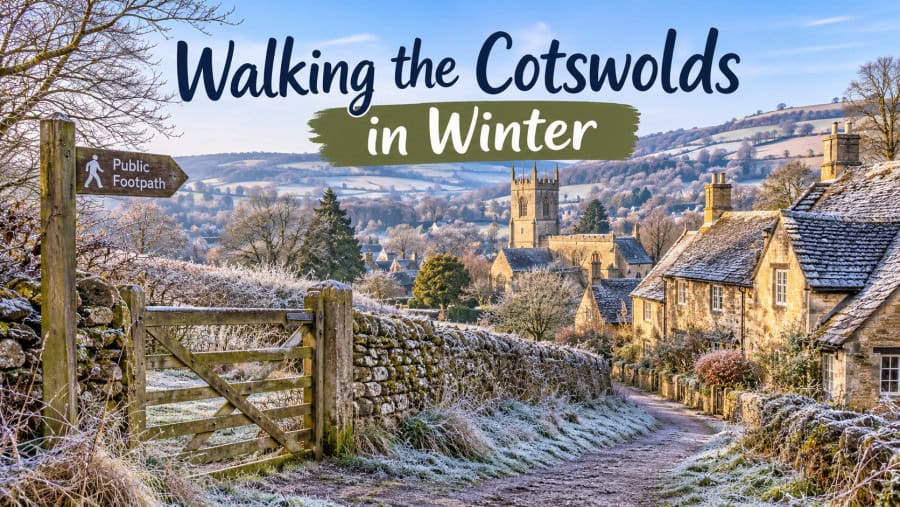
Winter. The Cotswolds in winter can be quieter, more atmospheric and, on the right day, spectacular. Frost can transform a muddy field into a crisp white landscape. Mist settles into the valleys. Bare trees reveal views that disappear beneath summer foliage, while the low winter sun throws long shadows across the hills.
And then there is the possibility – never guaranteed, but always exciting – of waking up to snow. The important thing is not to think of winter as a season when walking stops.
Instead, think of it as a chance to experience the Cotswolds differently.
Why walk the Cotswolds in winter?
The Cotswolds is famous for its villages, and understandably so. Bourton-on-the-Water, Bibury, Broadway, Castle Combe and Lower Slaughter attract visitors throughout the year.
But popularity has its drawbacks.
On a summer weekend, some of the best-known villages can be extremely busy. Car parks fill up, roads become congested and the narrow streets can feel a long way removed from the peaceful rural landscape you came to experience.
Winter changes all that.
The Cotswolds National Landscape points out that some locations, including Bibury, can be very busy with visitors, while also warning that between November and March paths can become muddy or slippery.
That combination is actually part of the attraction. Come on a cold weekday in January and you may find yourself walking through a village almost entirely on your own. The same streets that were crowded a few months earlier can feel wonderfully peaceful.
And once you leave the village behind, there is a good chance that the countryside will feel even more remote.
The Cotswolds looks different in winter
One of the pleasures of winter walking is discovering that the landscape hasn’t disappeared – it has simply changed.
The famous Cotswold stone looks particularly beautiful under low winter sunlight. Frost picks out the edges of dry-stone walls and hedgerows. Bare branches reveal church towers and distant hills that can be hidden during summer.
And if the weather turns misty, the landscape becomes almost mysterious.
A valley that you might normally regard as a pleasant agricultural landscape can suddenly become atmospheric and dramatic, with isolated trees disappearing into the mist and distant hills barely visible.
Then there are those rare, perfect winter days.
The temperature is below freezing, the sky is blue and every footstep produces that satisfying crunch of frozen ground.
These are the days when the Cotswolds can feel almost made for walking.
Don’t wait for snow
Snow is probably the image that most people associate with the winter Cotswolds. And when it arrives, the results can be spectacular.
The honey-coloured stone cottages, church towers, dry-stone walls and rolling hills can become a real-life Christmas card. But there is an important point to remember:
Don’t plan your winter walking around the expectation of snow.
Snow in the Cotswolds is unpredictable, and you may go through an entire winter without seeing a significant covering. Frost, mist, winter sunshine and even a crisp cold morning without a cloud in the sky can be just as rewarding. In fact, from a walking point of view, a frosty morning can sometimes be preferable to snow.
What are the paths like in winter?
This is where the romantic image of winter walking needs to meet reality. The Cotswolds may be beautiful, but its footpaths don’t magically become dry because the calendar has changed.
Quite the opposite.
The Cotswolds National Landscape specifically advises walkers that paths between November and March can be muddy or slippery and recommends checking the weather and wearing suitable footwear.
And the current winter walking programme from the National Landscape provides plenty of real-world evidence.
Recent guided walks have included warnings about substantial mud, wet ground and slippery paths. One seven-mile walk between Bledington, Church Westcote and Icomb was issued with a “MUD ALERT”, with walkers advised that some sections were muddy enough for wellington boots to be worth considering.
Other routes deliberately avoid the worst of the winter conditions. This is an important lesson:
You don’t necessarily have to stop walking because the ground is wet. You may simply need to change the type of walk you choose.
Choose the right walk for the weather
One of the best ideas to come from the Cotswolds National Landscape’s current winter walking programme is the use of country lanes.
Its “walking for the winter” routes are deliberately designed to escape the worst of the mud, using quiet lanes through villages and the surrounding countryside. Recent examples around Brimpsfield and Withington have been designed without stiles, gates or livestock, while still offering hills, views and attractive villages.
Of course, “lanes only” doesn’t mean completely mud-free. Farm lanes can still be wet, and walkers need to be aware of traffic. But the principle is excellent.
When the fields are saturated, change the route rather than giving up on walking. A week of heavy rain might not be the ideal time for a ten-mile footpath adventure across fields. It could, however, be a perfect opportunity for a shorter village-to-village walk using country lanes, with a café or pub waiting at the end.
Five different types of Cotswold winter day
One of the easiest ways to decide where to walk is to look at the weather first.
The crisp, sunny day
This is the day to head for the hills. The Cotswold escarpment offers some of the finest views in the region, and winter’s bare landscape can make those views even more expansive.
Cleeve Hill, Painswick Beacon, Leckhampton Hill and Broadway Tower are all good examples of places where you can gain height and make the most of a clear winter sky.
Just remember that exposed hills can be considerably colder and windier than the villages below.
The frosty day
Frost can be magical. Fields sparkle, trees are outlined in white and paths can actually become easier to walk than they were the previous week.
But beware of ice, particularly on shaded paths, steps, bridges and compacted sections of track. A walking pole can be surprisingly useful.
The misty day
Don’t automatically abandon the walk because you have lost the views. Mist creates a completely different experience.
Choose a route where the atmosphere, villages, woodland and close-up scenery are more important than distant panoramas. Woodland can be particularly rewarding in these conditions.
The wet day
This is when route selection really matters. Choose a shorter walk using lanes, tracks or firmer surfaces rather than committing yourself to miles of saturated farmland.
And have a Plan B. If conditions deteriorate, knowing that you can shorten the walk and return to the village can make all the difference.
The snowy day
If you are lucky enough to get snow, make the most of it – but don’t assume that your normal route will still be appropriate.
Footpaths can become difficult to see, gates can disappear beneath drifts and ice can make slopes hazardous.
A familiar five-mile route may be a much more sensible proposition than attempting a long-distance hike simply because the landscape looks beautiful.
Where are some of the best places for winter walking?
There are hundreds of possibilities across the Cotswolds, but several areas lend themselves particularly well to winter walking.
Broadway and Broadway Tower
Broadway is one of the classic Cotswold villages, but it is also an excellent starting point for a walk into the surrounding countryside.
The current Cotswolds National Landscape route from Broadway to Broadway Tower is around four miles and takes approximately 2½ to 3½ hours, with some steeper sections. It combines the village, historic tracks and the high ground around Broadway Tower, with extensive views across the Severn Vale and towards Wales on a clear day.
It is almost tailor-made for a winter day.
Walk through the village, climb onto the higher ground, enjoy the views and return to Broadway for something warm to eat or drink.
The route does, however, include muddy areas after wet weather, particularly around some of the gates and fields.
Cleeve Hill
For something more exposed, Cleeve Hill is difficult to beat.
As the highest common on the Cotswolds, it provides enormous views across the surrounding countryside.
Winter is particularly good for appreciating the scale of the landscape, but this is also somewhere where you need to take the weather seriously.
A sunny village morning can turn into a cold and windy experience on the exposed high ground.
Painswick and Painswick Beacon
The countryside around Painswick combines attractive villages, woodland, valleys and elevated viewpoints.
Painswick Beacon is another excellent choice when the weather is clear, giving walkers the opportunity to experience the escarpment without necessarily committing to a long-distance walk.
Woodchester Park
Winter isn’t all about hills.
Woodchester Park offers a completely different experience, with woodland, valleys and lakes.
The National Trust specifically highlights winter as a special time to visit. Frost-fringed lakes, mist, moss, lichen, fungi and winter wildlife all contribute to a very different sensory experience from walking there in summer.
It is a reminder that winter walking isn’t simply about finding the best viewpoint.
Sometimes the most rewarding walk is the one where you slow down and notice what is happening around you.
The Windrush Valley and its villages
The countryside around the Windrush provides another excellent winter option, particularly when combined with villages and sections of quieter lane.
The Cotswolds National Landscape currently uses modified winter routes in this area to avoid particularly difficult conditions. One nine-and-a-half-mile winter route around Little Barrington, Westwell and Signet was specifically adapted from a summer route because of the risk of flooding, while incorporating quiet lanes and attractive views.
That is another useful principle for winter walking:
A route that works beautifully in July may not be the best route in January.
Don’t underestimate winter daylight
There is another major difference between summer and winter walking.
Time.
In June, you can finish a walk in the evening and still have plenty of daylight. In December, the same distance can become much more demanding if you haven’t allowed enough time.
And winter conditions can slow you down. Mud takes more effort. Slippery paths require greater care. Stopping to negotiate a difficult section takes time. Poor visibility can slow navigation.
So don’t judge a winter walk purely by its mileage.
A useful Walking Academy rule is:
In winter, distance isn’t the only measure of difficulty. Conditions and daylight matter just as much.
Start earlier, allow some contingency and carry a headtorch if there is any possibility that you could still be walking around dusk.
What should you wear?
The most important thing is to dress for the countryside, not the village.
You may begin your walk wearing a warm jacket in a sheltered village and then find yourself climbing into a cold wind on the escarpment half an hour later.
For most winter Cotswold walks, I would want:
- – waterproof walking boots
- – warm layers that can be added or removed
- – a waterproof jacket
- – walking trousers
- – hat and gloves
- – spare socks
- – a small rucksack
- – a phone with sufficient battery
- – map or reliable navigation
- – a headtorch
- – food and a drink
- – walking poles can also be extremely useful on muddy or slippery slopes.
And don’t forget gaiters if conditions are particularly wet. You may not look quite as picturesque as the walkers in a summer walking brochure, but your feet will probably thank you.
The magic of the winter pub
There is another reason the Cotswolds is particularly suited to winter walking. The destination at the end of the walk can be almost as important as the walk itself.
Imagine leaving a village on a cold January morning, climbing through frosty fields, crossing the hills and eventually returning to a warm village pub.
Wet boots. Cold hands. Red cheeks. And then a roaring fire, a hot drink and something substantial to eat. That isn’t a consolation prize for walking in bad weather. It’s part of the experience.
The Cotswolds’ villages give you plenty of opportunities to build a walk around a café, pub or tearoom, although winter opening hours can be more restricted, so always check before setting off.
The National Landscape’s own route information frequently includes nearby cafés and pubs, and its Broadway route, for example, notes numerous cafés and pubs in the village as well as a café at Broadway Tower Country Park.
A winter walk doesn’t have to be a long walk
There can be a tendency among walkers to think that a “proper” walk needs to be ten miles or more.
Winter is a good time to forget that idea.
A three- or four-mile walk can be fantastic if the weather is poor.
The Cotswolds National Landscape’s current walking programme includes shorter winter routes specifically designed to use better surfaces and avoid the worst of the mud. One recent Kineton route, for example, was around 3½ miles and was designed to avoid the worst conditions, although waterproof footwear was still recommended for wet and muddy sections.
A shorter walk also gives you more flexibility. If conditions are excellent, you can extend it. If the weather deteriorates, you can return to the village. And if the forecast is particularly grim, you haven’t committed yourself to six hours in a rain-soaked field.
Sometimes three enjoyable miles are far better than ten miserable ones.
A simple winter walking checklist
Before setting off, ask yourself:
- Have I checked the weather? Not just the temperature – look at rain, wind, visibility and any weather warnings.
- Have I checked the route? Look for potential flooding, exposed sections, steep slopes and muddy areas.
- Will I finish before dark? Don’t rely on the time you normally take in summer.
- Are my boots suitable? Trainers might be perfectly adequate for a dry summer path. They are a very different proposition after several days of rain.
- Have I checked the pub or café? Particularly important in winter when opening hours can change.
- Do I have enough food and water? Don’t assume you’ll find an open shop or café along the way.
- Have I got a backup plan? If the weather turns nasty, know how you can shorten the walk.
And what about the wildlife?
Winter gives you a different opportunity to experience the Cotswolds’ wildlife.
The absence of leaves makes birds easier to spot, while winter visitors add another dimension to the landscape.
The Cotswolds National Landscape has even run dedicated winter bird walks, taking walkers across fields and up the escarpment in search of wintering birds.
Meanwhile, woodland areas such as Woodchester Park offer opportunities to see fungi, mosses, lichen and other signs of life that can be overlooked during the more visually spectacular months of spring and summer.
Winter walking can therefore encourage you to look differently.
- Instead of searching for wildflowers, look at the trees.
- Instead of looking for butterflies, listen for birds.
- Instead of searching for colour, notice texture, shape and light.
The Cotswolds in winter: embrace the uncertainty
Perhaps the biggest difference between a summer walk and a winter walk is that you can’t quite predict what you’re going to get.
You might set off under grey skies and discover blue sky an hour later.You might start in sunshine and find the summit covered in mist.You might get rain.You might get frost. And, if you’re very lucky, you might get snow.
That’s part of the fun.
The secret is to choose a walk that works with the conditions rather than fighting against them.
If the fields are flooded, use the lanes. If the wind is howling on the escarpment, find some woodland. If visibility is poor, choose a village-based route. If the sun comes out, head for the hills.
So, is winter a good time to walk in the Cotswolds?
Absolutely.
But don’t expect it to be summer with colder temperatures. Winter walking requires a slightly different approach. You need to pay more attention to the weather, daylight and ground conditions. You may need better footwear, a shorter route or a different type of walk.
But in return, you can experience a side of the Cotswolds that many visitors never see. Quiet villages. Empty paths. Frosty fields. Misty valleys. Bare trees. Low winter sunlight.
And perhaps, just occasionally, a landscape covered in snow.
The Cotswolds doesn’t stop being beautiful when the leaves fall. In some ways, that’s when you start to see it properly. So if you normally put your walking boots away when November arrives, perhaps this is the year to leave them by the door.
The Cotswolds is waiting. And winter might just be the best time to discover it.
Looking to walk the Cotswolds in winter? Find out why it’s the perfect place for a cold day out
Recent Posts
Winter Hiking Clothing Tips: Stay Warm and Comfortable on the Trail
When winter arrives, many hiking trails become covered in snow and ice, creating a winter wonderland for hikers. However, hiking in cold weather requires a different approach to clothing. Wearing the...
Winter Hiking Tips: Embrace the Colder Months with Confidence
Winter hiking offers a captivating opportunity to explore nature's frozen beauty, presenting a unique experience with snow-draped landscapes, frosted peaks, and serene woodlands. In this...