

Table of Contents
Some links on posts are affiliate links and will earn us a commission from qualifying purchases
Whether you are tackling the West Highland Way or enjoying a brisk Sunday stroll in the Peak District, you have likely experienced that strange buzzing feeling after a long day on your feet. You finally sit down with a cup of tea, the hills are quiet, and your pack is off, yet your body refuses to settle. Your legs feel twitchy, your jaw is clamped shut, and your mind is already racing through tomorrow’s elevation profile. Put simply, you cannot reax your body in order to recover from your day’s hiking endeavours.
As the psychologist Carl Rogers famously said, the curious paradox is that when I accept myself just as I am, then I can change. For a hiker, this means acknowledging that an inability to relax isn’t a lack of discipline. It is a specific signal from your nervous system.
Understanding Your Hiker’s Nervous System
When you cannot settle down despite being in a safe environment, it usually means your sympathetic nervous system is still mobilised. This is the system responsible for the fight or flight response. The energy prepared for the climb has nowhere to go, so it circulates through your muscles and nervous tissue.
This residual activation is common after a demanding day in the fells. Your body is still processing physical stress that your conscious mind has already moved past. Here is how to interpret those common trail side signals:
Common Physical Signals and Their Meaning
- Restless Legs: This is often a sign that your body still has mobilised energy for movement and does not know where to put it.
- Clenched Jaw: This typically indicates suppressed fight energy or a bracing pattern, as if you are preparing for an impact that never comes.
- Shallow Breathing: This suggests your nervous system is still scanning for threats and does not feel safe enough to fully let go.
- Cold Hands and Feet: Blood flow is being directed to your core and large muscles for survival rather than your extremities.
The 20 Minute Stand Down Routine
Most hikers respond to tension by trying harder to relax. We force ourselves to lie still or criticize ourselves for being restless. This actually increases stress because it applies a control based approach to a system that needs permission to rest. Instead, try this twenty minute transition at camp or when you get home.
Phase 1: Mechanical Release (0 to 7 Minutes)
Start by honouring the movement your body thinks it still needs. Stand up and gently shake your arms and legs for a minute to discharge adrenaline. If you are at camp, lie on your back and rest your heels up against a tree or your rucksack. This assists blood flow back to the heart and signals that the vertical work is finished.
Phase 2: Sensory Grounding (7 to 15 Minutes)
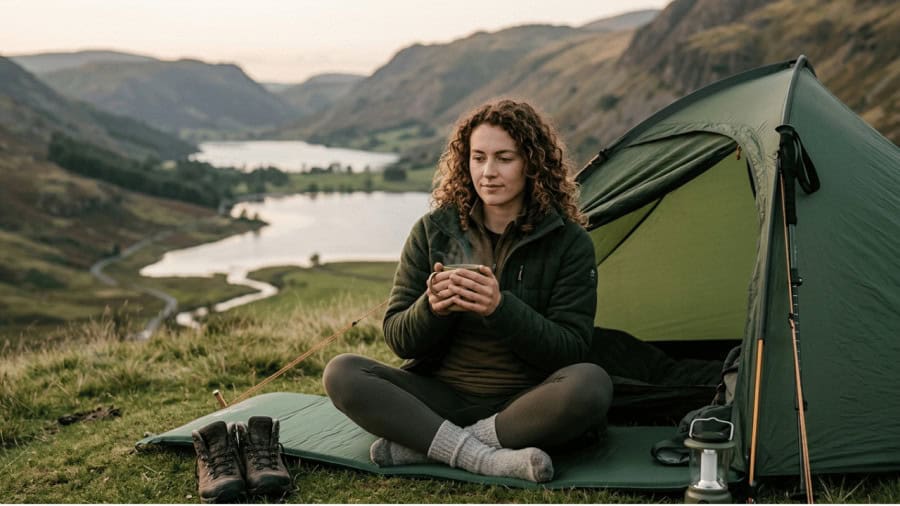
Put on your dry base layers or a warm fleece immediately. Warmth is a primary safety signal to the brain. Sip a warm drink slowly. The rhythmic action of swallowing stimulates the vagus nerve, which tells your heart rate to slow down. Try to soften your gaze by looking at the horizon rather than staring intensely at your stove or a phone screen.
Phase 3: The Breath Bridge (15 to 20 Minutes)
You cannot force a deep breath, but you can control the release. Try the 4-7-8 technique. Inhale through your nose for a count of four, hold for seven, and exhale forcefully through your mouth for a count of eight. A long, resisted exhale is the fastest way to trigger the rest and digest system.
Feeding the Recovery System
To move from muscle breakdown to repair, your body needs the right chemical environment. On the trail, the goal is to lower inflammation and provide building blocks for the next day.
- The Golden Hour: Try to eat a small snack within forty five minutes of finishing your hike. A mix of carbohydrates and protein, such as nuts and dried fruit, helps stop the production of cortisol.
- The Relaxation Mineral: Focus on magnesium rich foods like pumpkin seeds, almonds, or dark chocolate. Magnesium helps prevent the restless legs and cramping that keep you awake.
- Anti Inflammatory Spices: Adding ginger or turmeric to your evening meal can help dampen the physical signals of joint inflammation.
- The Sleep Signal: A warm herbal tea, such as chamomile or peppermint, provides the warmth and ritual your nervous system craves to feel safe.
The Morning Mobility Sequence
Morning stiffness is often just your nervous system still bracing from yesterday. Before you shoulder your pack, spend five minutes lubricating your joints.
- Ankle Alphabets: Sit down and use your big toe to draw the entire alphabet in the air. This recalibrates your balance after your feet have been locked in stiff boots.
- The Low Lunge: Step into a gentle lunge and pulse your hips forward and back. This opens the hip flexors which become shortened during steep climbs.
- The Summit Reach: Interlace your fingers and push your palms toward the sky. Reach side to side to open your ribcage, making it easier to take deep breaths once you start moving.
Frequently Asked Questions
Why do my legs twitch specifically at night after hiking? This is often a combination of lactic acid buildup and your nervous system remaining in a state of high alert. Following a decompression routine and increasing your magnesium intake can help.
Is it better to stretch or move in the morning? Gentle movement is usually better than deep, static stretching for hikers. You want to lubricate the joints and wake up the nerves rather than pulling on cold muscles.
What should I do if I still feel wired after a hike? Focus on your exhale. By making your breath out longer than your breath in, you send a direct message to your brain that the danger has passed and it is safe to sleep.
Conclusion
Genuine rest is not just the absence of hiking. It is the presence of safety. Your body cannot switch from high alert to deep recovery instantaneously. By building a short transition period into your routine and listening to your physical signals as information rather than problems to fix, you ensure you are ready for the miles ahead. Rest is not an indulgence; it is a biological necessity for every hiker.
Learn how to relax your body after a long day in the fells with our guide to nervous system recovery for hikers.
Recent Posts
Walking can ease joint pain, keep cartilage nourished, and strengthen the muscles that support your knees, hips and ankles. A short, regular walking habit often improves mobility and reduces...
Walking vs. Running: Which Is Better for Fitness and Health?
You can get fit with either walking or running, but which one suits you depends on your goals, time and body. If you want faster calorie burn and stronger bones, running wins; if you need lower...