

Table of Contents
Some links on posts are affiliate links and will earn us a commission from qualifying purchases
Are you looking for 2-day walks in South East England, perfect for a weekend escape with some gentle exercise thrown in?
For many, “South East England” conjures images of rolling hills, sleepy villages, and the occasional white cliff. But for the dedicated hiker, this corner of the UK offers some of the most diverse and historically rich terrain in Europe.
From the ancient “highways” used by pilgrims to the rare lowland heathlands that are technically scarcer than tropical rainforests, a two-day trek here is more than just exercise – it’s an immersion into the landscape that shaped British history.
It’s been my home all my life, so I may be biased, but I think the South East has so much to offer, especially for a weekend hiking.
Why South East England is Perfect for a 2-Day Adventure
Accessibility from London: The “Trail-to-Train” Connection
The beauty of hiking in the South East is the “radial” nature of the rail network. Most major trails cross or begin at stations served by London’s termini (Waterloo, Victoria, London Bridge, and Marylebone). You can leave your office on a Friday afternoon and be at a trailhead in the Surrey Hills or the Kent coast in under an hour. This eliminates the need for a car, making linear walks – where you start at one station and end at another – the gold standard for weekend adventures.
Diverse Landscapes and Terrain
The region is defined by its geology. The Chalk Ridges of the North and South Downs provide elevated “balcony” views over the Weald, a lowland area of ancient clay and sandstone once covered by a massive forest (The Andredsweald). To the east, the Saxon Shore offers coastal marshes and maritime history, while the Greensand Ridge provides acidic soils that support stunning purple heather and pine forests.
Well-Established Trail Infrastructure
As the home to several National Trails, the South East is impeccably waymarked. The iconic “Acorn” symbol of the National Trails and the distinct colour-coded discs of local paths (like the Serpent Trail) mean you spend less time squinting at a map and more time enjoying the view.
Excellent Accommodation Options
Whether you’re a “wild camper” (where legal and discreet), a hostel-goer, or a fan of the traditional English pub, the infrastructure is unparalleled. Many villages along these routes have been hosting travelers for a thousand years, resulting in a dense concentration of historic inns that offer local ales and locally sourced food – perfect pick me ups for lunch or after a long walk.
Top 5 2-Day Hiking Itineraries: Detailed Breakdowns
1. South Downs Way: Alfriston to Eastbourne (The Coastal Classic)
This route is often cited as the most spectacular stretch of the 100-mile South Downs Way. It transitions from the lush, pastoral Cuckmere Valley to the dramatic, wind-swept white cliffs of the Seven Sisters.
Day 1: Alfriston to East Dean (~10 miles)
- The Start: Begin in Alfriston, a village so picturesque it feels like a film set. Visit the Clergy House, the first property ever bought by the National Trust.
- The Route: Follow the meandering River Cuckmere south. The path is flat and easy until you reach Litlington, home to a famous “White Horse” carved into the chalk hillside.
- The Climb: As you approach the coast, the terrain shifts. You’ll ascend through Friston Forest before dropping down into the Seven Sisters Country Park.
- Highlights: The view from Exceat across the Cuckmere Haven is iconic – the point where the river meets the sea in a series of silver loops.
- Overnight: Stay in East Dean. The Tiger Inn sits on a classic village green and offers cozy rooms and hearty food.
Tiger Inn is a quintessential hiker-friendly stop located right on the village green in East Dean, perfectly positioned for those tackling the Seven Sisters.
- Features oak beams and open fires that provide a classic, cozy atmosphere after a day on the cliffs.
- The bar is very welcoming to walkers and dogs, often serving as a central hub for hikers on the South Downs Way.
Long Man Inn in Wilmington is an independent Edwardian pub nestled at the foot of the downs, making it an ideal base for visiting the famous “Long Man” chalk carving.
- Offers four dedicated overnight guest rooms specifically marketed toward walkers and cyclists.
- Serves traditional food and local ales, with a dog-friendly policy throughout the bar area.
Day 2: East Dean to Eastbourne (~12 miles)
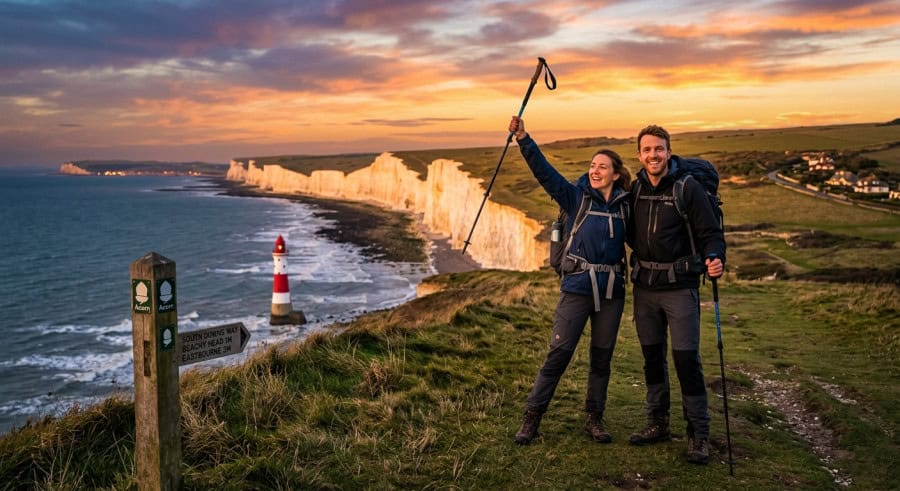
- The Seven Sisters: This is the “rollercoaster” section. You will crest seven distinct chalk cliffs (Haven Brow, Short Brow, Rough Brow, Brass Point, Flagstaff Point, Bailey’s Hill, and Went Hill). The views of the English Channel are peerless. Speaking from experience, this can be windy – but you should be heading in the right direction and getting assisance.
- Birling Gap & Beachy Head: Stop at the National Trust cafe at Birling Gap to see the effects of coastal erosion firsthand. Then, climb to Beachy Head, the highest chalk sea cliff in Britain (162m). Look out for the red-and-white striped lighthouse in the sea below.
- The Descent: The trail ends with a long, grassy descent into Eastbourne, where you can celebrate with fish and chips on the Victorian pier.
- Distance: ~22 miles total.
- Elevation: High (constant short, steep climbs on the cliffs).
- Transport: Train to Lewes, then bus to Alfriston. Return via Eastbourne station.
2. North Downs Way: Dorking to Reigate (Surrey Hills Heart)
The North Downs Way follows the historic Pilgrims’ Way. This section cuts through the Surrey Hills National Landscape, offering a mix of deep woodland and “balcony” views over the southern counties.
Day 1: Dorking to Box Hill (~8 miles)
- The Start: Start at Dorking Deepdene. Walk through Denbies Wine Estate, England’s largest vineyard. In autumn, the rows of vines turning gold against the chalk soil are a sight to behold.
- The Stepping Stones: Cross the River Mole via the famous stepping stones (if the water level is low) before tackling the “Cardiac Hill” – the 275 steps leading to the summit of Box Hill.
- Overnight: There are several hotels at the foot of Box Hill, or you can head into Dorking for a wider range of B&Bs.
Day 2: Box Hill to Reigate (~9 miles)
- The Ridge Walk: Follow the escarpment east. This section is heavily wooded but breaks out into frequent viewpoints. You’ll pass Colley Hill, where you might see paragliders catching the thermals.
- History: Look for the Inglis Folly (a stone drinking fountain) and the remains of WWII pillboxes built to defend London from a southern invasion.
- The Finish: Descend through the grounds of Gatton Park, designed by the legendary Lancelot “Capability” Brown, before finishing in the historic market town of Reigate.
- Distance: ~17 miles total.
- Elevation: Moderate to High (Box Hill is the primary challenge).
- Transport: Dorking (Station/Deepdene/West) and Reigate station.
The White Horse, A Heartwood Inn, is one of England’s oldest coaching inns, located in the heart of Dorking and within easy reach of the North Downs Way and Box Hill.
- Provides specialized “Cycle, Sip, Supper & Sleep” packages that cater to active travelers.
- Includes practical amenities for outdoor enthusiasts, such as a dog shower and a “stick library” for four-legged hiking companions.
The Abinger Hatch is a quintessential country pub in Abinger Common, surrounded by the woodlands of the Surrey Hills and popular among hikers taking a detour from the main ridge.
- Features two log-burning fires and a large garden tipi, offering comfort in both winter and summer.
- Renowned for its “muddy boots and dogs welcome” attitude, making it a stress-free stop during a long trek.
3. The Serpent Trail: Haslemere to Midhurst (Heathland Escape)
Named for its “snaking” path through the West Sussex greensand hills, this trail is a masterclass in biodiversity. Lowland heath is a rare habitat characterized by gorse, heather, and sandy tracks.
Day 1: Haslemere to Black Down (~10 miles)
- The Start: Start at Haslemere High Street (the “Serpent’s Tongue”). The climb out of town leads quickly to Black Down, the highest point in the South Downs National Park (280m).
- The Views: From the “Temple of the Winds” on Black Down, you can see across the Weald to the North Downs. This was a favorite haunt of the poet Alfred Lord Tennyson.
- Overnight: Stay in the village of Lurgashall or find a local farm stay near the Black Down foothills.
Day 2: Black Down to Midhurst (~10 miles)
- The Heathlands: This section takes you through Woolbeding Common, a sprawling expanse of heather and gorse. In late summer, the landscape turns a vivid, electric purple.
- The River Rother: The trail eventually drops down into the lush valley of the River Rother.
- The Finish: Arrive in Midhurst, famous for the Cowdray Ruins – a Tudor mansion destroyed by fire in 1793. The town itself is full of timber-framed buildings and excellent tea rooms.
- Distance: ~20 miles total.
- Elevation: Moderate (Black Down is a long but steady climb).
- Transport: Haslemere station (start); Bus from Midhurst to Haslemere or Chichester (end).
The Swan Inn in Midhurst serves as an excellent midpoint for the Serpent Trail, combining 15th-century Tudor architecture with modern boutique comfort.
- Located in the heart of a historic market town, providing easy access to local amenities and the Cowdray Ruins.
- Features rooms with traditional oak beams and “wonky” floorboards that reflect its coaching inn history.
The George & Dragon, A Heartwood Inn, in Marlow is a Grade II listed gastro pub located just moments from the Thames Path, ideal for those seeking a touch of luxury on their riverside walk.
- Offers “Snug” rooms that are designed specifically for solo travelers or couples looking for a cozy, efficient stay.
- The terrace and bar area provide a relaxed setting for a post-hike drink while overlooking the vibrant town of Marlow.
4. The Thames Path: Windsor to Marlow (River Serenity)
For a more meditative, less vertical experience, the Thames Path offers “River Serenity.” This stretch is steeped in Royal history and literary associations (think Three Men in a Boat or The Wind in the Willows).
Day 1: Windsor to Maidenhead (~8 miles)
- The Start: Begin in the shadow of Windsor Castle. The path heads upstream, passing the famous playing fields of Eton College.
- Boveney Lock: Stop at the 12th-century St Mary’s Church in Boveney, a tiny stone chapel sitting solitary in the meadows.
- The River Life: Watch the colorful narrowboats pass through the many locks. This section is exceptionally flat and well-paved.
- Overnight: Maidenhead offers plenty of options, from riverside hotels to budget-friendly chains.
Day 2: Maidenhead to Marlow (~9 miles)
- Boulter’s Lock: Pass through this famous lock, once the “place to be seen” for Victorian high society.
- Cliveden Reach: The river narrows as it flows beneath the wooded hanging cliffs of the Cliveden Estate. The views of the grand house above the trees are spectacular.
- Cookham: Stop in Cookham to visit the Stanley Spencer Gallery. The village itself is charming and was the inspiration for much of Spencer’s religious-pastoral art.
- The Finish: End in Marlow, crossing the beautiful suspension bridge. Marlow is a foodie hotspot—perfect for a post-hike meal.
- Distance: ~17 miles total.
- Elevation: Minimal (almost entirely flat).
- Transport: Windsor & Eton Riverside/Central; Marlow station (via a short branch line to Maidenhead).
5. Saxon Shore Way: Whitstable to Faversham (Coastal Heritage)
This walk explores the “Old Coastline” of Kent. It’s a landscape of wide skies, salt marshes, and deep maritime history.
Day 1: Whitstable to Seasalter (~7 miles)
- The Start: Start at Whitstable, famous for its oysters. Explore the “The Favourite” (the last remaining oyster yawl) and the colorful beach huts.
- The Coast: Walk along the sea wall towards Seasalter. This is a prime spot for birdwatching – keep an eye out for avocets and curlews in the mudflats.
- Overnight: Stay in Seasalter or head slightly inland to a local inn. The Sportsman is a Michelin-starred pub here (book months in advance!).
Day 2: Seasalter to Faversham (~9 miles)
- The Marshes: The path turns inland following Faversham Creek. This is a “moody” landscape of rusting boat hulls, salt-crusted docks, and vast marshy horizons.
- Maritime History: As you approach Faversham, you’ll pass the Standard Quay, where historic Thames Sailing Barges are still restored.
- The Finish: End in the center of Faversham, a town with over 500 listed buildings and the oldest brewery in Britain (Shepherd Neame).
- Distance: ~16 miles total.
- Elevation: Minimal.
- Transport: Whitstable station (start); Faversham station (end).
Sun Inn in Faversham is a 14th-century inn that perfectly captures the heritage of the Saxon Shore Way, located just a short walk from the local brewery and the creek.
- Boasts twelve boutique bedrooms that pair historic period features with modern conveniences like Simba mattresses for a good night’s sleep.
- Known for its courtyard garden and traditional inglenook fireplaces, providing various spaces to relax regardless of the weather.
The White Horse Inn in Boughton-under-Blean is an ancient inn mentioned in Chaucer’s “Canterbury Tales,” making it a must-stay for history-loving hikers near the end of their journey.
- Recently refreshed rooms offer a blend of vintage style and contemporary comfort.
- The bar features a deli counter with local Kentish produce, ideal for picking up snacks for the next day’s walk.
How to Plan Your Perfect 2-Day Walk
Choosing the Right Trail for Your Fitness
- Beginner/Relaxed: The Thames Path or Saxon Shore Way. Flat ground means you can focus on the scenery without worrying about burning calves.
- Intermediate: The Serpent Trail. Rolling hills and sandy tracks require a bit more stamina but aren’t punishing.
- Challenging: The South Downs Way or North Downs Way. The constant elevation changes over the cliffs or the chalk ridge require good cardiovascular fitness and decent knees!
Booking Accommodation in Advance
In the South East, “spontaneous” accommodation is risky, especially on weekends.
- Pub Stays: These are the soul of British hiking. Search for “Inns with rooms” for the most authentic experience.
- Luggage Transfer: If you don’t want to carry a heavy pack, services like Sherpa Van or Move My Bags operate on the South Downs and North Downs Ways. They will move your suitcase from one B&B to the next for around £15-£20 per bag.
Transport Logistics: The “Station-to-Station” Strategy
Always check the National Rail Enquiries app before setting off. Engineering works on weekends are common in the South East.
- Tip: Buy a “Network Railcard” if you live in the South East; it gives you 1/3 off most rail fares for you and a friend.
The Essential 2-Day Hike Gear List
1. The Core Setup (Non-Negotiables)
Regardless of your route or accommodation, these items must be in your pack.
- Rucksack: * B&B/Hostel: 20–30 Litres. (You only need space for snacks, water, and a change of clothes).
- Camping: 45–60 Litres. (To accommodate a tent and sleeping system).
- Navigation: * Physical: OS Explorer Map (1:25,000) and a baseplate compass.
- Digital: OS Maps or AllTrails app (with offline maps downloaded).
- Backup: A fully charged power bank (10,000mAh+) and charging cables.
- Hydration: 2L capacity minimum. Use a hydration bladder for the South Downs (fewer stops) or a filter bottle (e.g., Water-to-Go) for the Thames Path.
2. The Clothing “Layering” System
The South East is prone to rapid weather shifts. Avoid cotton, which stays wet and cold; choose Merino wool or synthetic “wicking” fabrics.
| Layer | Item | Why? |
| Base | Wicking T-shirt / Long sleeve | Moves sweat away from skin. |
| Mid | Lightweight Fleece or “Puffy” Jacket | Traps heat. Essential for when you stop to eat. |
| Outer | Waterproof Shell (Gore-Tex or similar) | Must be breathable but 100% rainproof. |
| Bottoms | Quick-dry hiking trousers | Avoid jeans at all costs. |
| Feet | Merino wool socks (e.g., Darn Tough) | Prevents blisters and stays warm when damp. |
| Extras | Buff (neck gaiter) & lightweight hat | Regulates temperature easily. |
See here for more info on what to wear.
3. Footwear: Choice by Terrain
- The “Cliffs & Ridges” (South/North Downs): Mid-cut hiking boots or sturdy trail runners. The chalk can be slippery when wet and hard on the joints when dry.
- The “River & Coast” (Thames/Saxon Shore): Lightweight walking shoes or breathable trail runners. Ankle support is less critical here.
- Evening Wear: Lightweight flip-flops or “camp shoes” to let your feet breathe after a 12-mile day.
4. The Overnight Kit (Accommodation vs. Camping)
Staying in a B&B / Inn
- Change of clothes: Lightweight “pub attire” (clean shirt/trousers).
- Toiletries: Travel-sized toothbrush, toothpaste, and deodorant.
- Earplugs: Essential if staying in an old, creaky historic inn.
Camping (Self-Sufficient)
- Shelter: Lightweight 1-2 person tent (under 2kg).
- Sleep System: 3-season sleeping bag + inflatable sleeping mat (the ground in the South East is often hard chalk).
- Cooking: Small stove (e.g., Jetboil), spork, and a lightweight mug.
- Hygiene: Biodegradable soap, a trowel, and “leave no trace” waste bags.
5. Health, Safety & “Trail Magic”
- First Aid: Blister plasters (Compeed is the gold standard), ibuprofen, antiseptic wipes, and suncream (SPF 30+).
- Emergency: A loud whistle (usually on rucksack chest straps) and a foil “survival” blanket.
- Trekking Poles: Highly recommended for the Seven Sisters. They reduce the impact on your knees by up to 25% on descents.
- Sit Mat: A small foam square. The South East has many beautiful views but surprisingly few benches; a sit mat keeps your bum dry during lunch.
6. Food & Fuel
- Lunch: Pre-made wraps or “dense” sandwiches.
- Energy: Trail mix, salted nuts (for electrolytes), and “Oaty” bars.
- The “Secret Weapon”: Electrolyte tablets for your water. On a humid day in the Surrey Hills, these prevent the dreaded “afternoon slump.”
Best Time to Visit
- Spring (April – May): Bluebells in the Surrey Woods and wildflowers on the Downs.
- Summer (June – August): Longest daylight hours, but can be hot (the chalk reflects heat).
- Autumn (September – October): The best for the Serpent Trail (heather) and the Thames Path (golden leaves).
- Winter (November – March): Can be muddy and bleak, but the “Big Skies” of the Kent coast are stunning on a crisp, frosty morning.
Frequently Asked Questions
What fitness level is required?
For the cliff sections of the South Downs, you should be comfortable walking 10+ miles on hilly terrain. For the Thames Path, anyone with basic walking fitness can enjoy it.
How much does a 2-day walk cost?
If staying in B&Bs and eating at pubs, budget around £150–£200 per person for the weekend. If camping and packing your own food, this can drop to £40–£60 (mainly rail fares).
Can I do these walks solo?
Absolutely. These routes are among the safest in the world. The paths are well-traveled, and you’re rarely more than a few miles from a village.
Do I need special equipment?
No specialist mountaineering gear is needed. However, walking poles are highly recommended for the South Downs Way to help with the steep descents on the Seven Sisters. After first using walking poles on steep hills, I never go without them now.
Final Thoughts: Start Your Adventure
A two-day hike is the perfect “reset button.” It’s long enough to distance yourself from the digital noise of daily life, but short enough that it doesn’t require weeks of planning or specialized gear. The South East of England is waiting – all you need is a pair of boots and a rail ticket.
Recent Posts
Whether you are preparing for a weekend getaway or a month long distance hike, your body is essentially a high-performance vehicle. We often focus on the gear - the lightweight boots, the carbon...
Whether you are tackling the West Highland Way or enjoying a brisk Sunday stroll in the Peak District, you have likely experienced that strange buzzing feeling after a long day on your feet. You...